
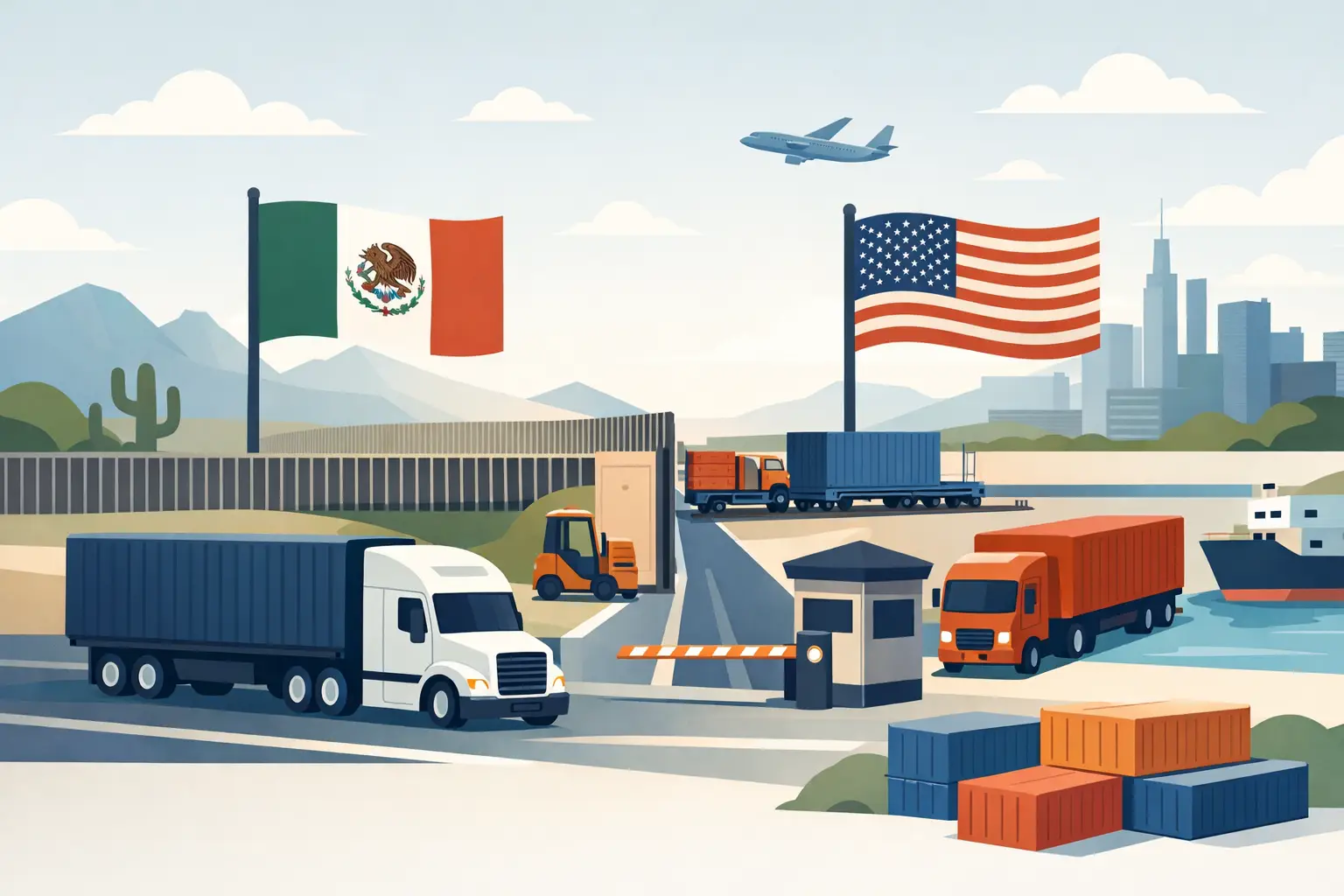
A truck hits the border on time, the commercial invoice is clean, and the freight is still late. That usually means the problem is not linehaul. It is handoff execution. In cross border drayage Mexico, the highest-risk moments happen when freight changes custody, clears customs, shifts equipment, or waits on a yard that is not synchronized with the paperwork.
For shippers moving freight between Mexico and the United States, drayage is not just a short-haul transport leg. It is the control point between customs, carrier availability, facility timing, trailer strategy, and final delivery performance. If that control point is weak, the whole move slows down.
What cross border drayage Mexico actually means
At a practical level, cross border drayage Mexico refers to the short-distance movement of freight through the border zone, typically between shipper facilities, transfer yards, customs inspection points, warehouses, and long-haul carriers on either side. In the US-Mexico corridor, this often involves dropping one trailer, transferring freight, or repositioning a loaded unit so another carrier can continue the move.
The exact structure depends on the crossing, commodity, customs setup, and security requirements. Some moves use trailer interchange. Others rely on transloading at a bonded or non-bonded facility. In many cases, drayage supports a split operation where a Mexican carrier handles the Mexico leg, a drayage carrier manages the border transfer, and a US carrier completes final delivery.
That sounds straightforward until exceptions start stacking up. A driver misses a pickup window. The pedimento is not ready. The US entry is filed but flagged for review. The receiving warehouse changes hours. The drayage leg is where all of those issues surface at once.
Why drayage is the pressure point in cross-border freight
Cross-border transportation fails at the handoffs, not the PowerPoint level. Everyone involved may be doing their own job correctly, but if those jobs are not coordinated in one sequence, the shipment still stalls.
Drayage sits in the middle of that sequence. It has to align with customs release timing, yard capacity, equipment availability, and appointment scheduling. It also has to absorb variability that linehaul carriers usually cannot. If a customs hold clears at 3:40 p.m., the drayage provider has to react quickly enough to recover the move. If not, the shipment rolls into the next day, and the delay spreads downstream.
This is why experienced operators treat drayage as an execution function, not a commodity purchase. The cheapest local truck does not help if it cannot coordinate with customs brokers, transload teams, and receiving facilities in real time.
How the process usually works
Origin pickup and export preparation
Freight starts at a manufacturing plant, supplier, or warehouse in Mexico. Before the truck gets near the border, the shipment data has to be right. That includes product details, invoice values, consignee information, tariff classification support, and any commodity-specific requirements.
If the export-side documentation is late or inaccurate, drayage timing breaks before the truck even departs. The border is not the place to discover invoice mismatches or missing shipment references.
Border transfer and customs coordination
Once freight reaches the border zone, drayage operations take over the critical transition. Depending on the lane, that can mean moving the loaded trailer to a transfer yard, positioning freight for transloading, or staging equipment for customs release and pickup by the next carrier.
This stage has very little tolerance for disconnected communication. Customs status, trailer status, and driver status all need to be current. If one party is still working from email chains and another is dispatching from a separate system, delays multiply fast.
US-side delivery or relay
After release, the shipment either moves directly to final delivery or into another warehouse, cross-dock, or distribution point. Not every load should go direct. For some freight, especially high-volume or mixed-mode shipments, a relay through a staging facility improves utilization and keeps appointments intact.
The trade-off is obvious. More touchpoints can add control, but they also add handling risk. The right choice depends on the commodity, the service level, and how tight the delivery window is.
The three operating models shippers usually choose
Some importers rely on a segmented model. One customs broker handles filing, one drayage provider handles the border move, and a separate carrier handles long-haul delivery. This can work if the shipper has a strong internal transportation team and enough volume to actively manage exceptions.
Others use an asset-based carrier network that can cover more of the move under one umbrella. That reduces some handoffs, but it does not automatically solve customs coordination or document processing. A truck network alone is not a border operating system.
The third model is unified execution, where customs, drayage, and inland transportation are managed in one workflow. That is usually the most stable option for time-sensitive freight because one party owns the sequence, not just one leg. When problems happen, accountability is clearer and recovery is faster.
Where delays really start
Bad document timing
Most border delays blamed on customs actually begin earlier with document intake. Commercial invoices arrive incomplete. Packing lists do not match piece counts. Product descriptions are too vague to support classification. Teams spend hours chasing revisions while the truck waits.
This is one reason automation matters, but only if it fits real operations. If a system requires every supplier to learn a new portal, adoption falls apart. The better approach is to capture the data from the channels people already use and push it directly into customs and dispatch workflows.
Yard congestion and equipment mismatch
Border yards can become bottlenecks when appointment schedules, trailer pools, and outbound capacity are not aligned. A shipment may be customs-cleared but still sit because the right trailer is unavailable or the receiving side is backed up.
Drayage planning has to account for those physical constraints. Freight does not move because the spreadsheet says it should. It moves when a driver, a trailer, a release, and a facility slot line up at the same time.
Weak exception management
Cross-border freight rarely runs on a perfect first plan. Holds happen. Drivers run late. Facilities shift schedules. The real test is how quickly the operator spots the issue and resets the sequence.
That takes visibility across customs status, transportation status, and warehouse status in one view. If those updates live in separate inboxes or vendor portals, the team reacts too late.
What good cross border drayage Mexico looks like
A strong drayage operation is predictable under pressure. Pickup and transfer events are visible. Customs milestones are tied to dispatch decisions. Facilities know when freight is actually arriving, not when it was supposed to arrive three hours ago.
It also means the provider understands the difference between normal variability and controllable waste. Some border delays are real compliance events. Others come from poor sequencing, duplicate data entry, and lack of ownership between vendors.
This is where technology should help operators move faster, not create another layer of admin. The best systems remove manual rekeying, reduce status chasing, and connect documents directly to execution. No portal. No login. No change to your workflow.
In high-volume gateways such as Laredo, that discipline matters even more because small timing failures compound quickly. A missed handoff in a dense border market can turn into missed linehaul capacity, storage fees, and late delivery penalties by the end of the day.
How to evaluate a drayage setup before it breaks
Ask a simple question: who owns the move when something goes wrong? If the answer changes depending on whether the issue is customs, transfer, or final-mile scheduling, the model is fragmented.
You should also look at how shipment data enters the operation. If your team is still forwarding documents manually between brokers, carriers, and warehouses, you are carrying avoidable risk. The more times data is touched, the more likely it is to break the timeline.
Finally, evaluate the provider's recovery speed, not just its base service promise. Border operations are judged on exception handling. A provider that gives quick, accurate updates and can reroute a shipment without restarting the whole workflow is far more valuable than one that only performs when everything goes according to plan.
BorderFlow was built around that reality. Customs, drayage, and inland freight perform better when they are run as one operating sequence, supported by automation that works in the background instead of forcing the shipper to change systems.
Cross-border freight will never be frictionless, and anyone selling that story is skipping the hard parts. But cross border drayage Mexico can be controlled far more tightly when one workflow connects documents, customs, equipment, and delivery timing from start to finish. The win is not just fewer delays. It is fewer surprises.