
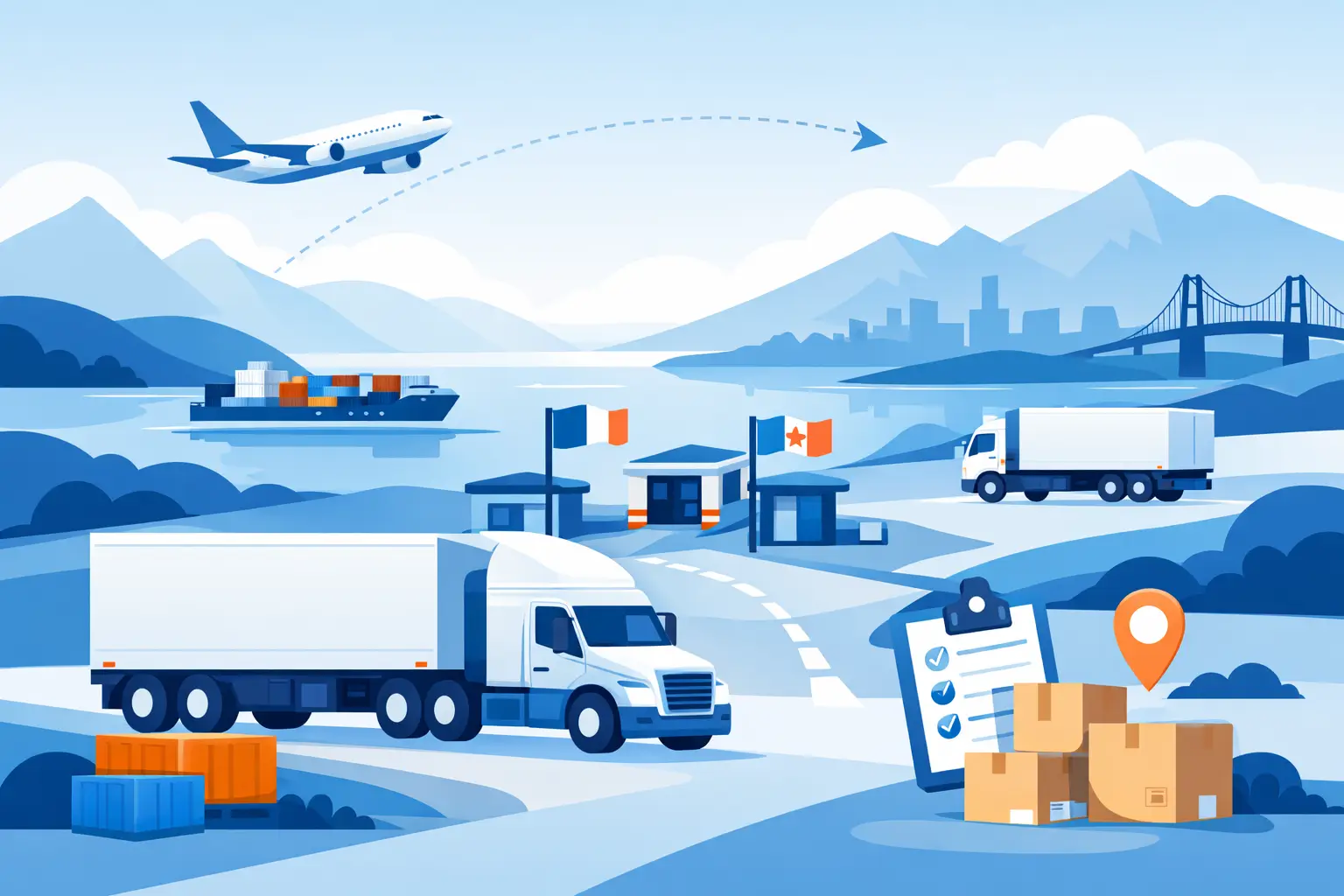
If your team is still treating cross border freight like three separate jobs - customs, drayage, and linehaul - you're probably paying for the gaps between them.
That shows up fast on the US-Mexico corridor. A shipment is ready at origin, but commercial documents arrive late. The broker is waiting on corrected data. The carrier has one schedule, the drayage provider has another, and nobody owns the full move. By the time freight reaches the border, delay isn't caused by one big failure. It's caused by a chain of small handoff problems.
For operators, that is the real issue with cross border execution. The border itself is not the only source of friction. The bigger problem is fragmented control.
What cross border actually means in operations
In theory, cross border is simple. Freight moves from one country to another and clears customs along the way. In practice, US-Mexico freight is a coordinated sequence of filings, transfers, inspections, appointments, and carrier moves that has to stay aligned from pickup through final delivery.
A single shipment may involve export data, commercial invoices, packing lists, classification review, US entry filing, Mexican customs processing, pedimento coordination, drayage across the border, and domestic delivery on the other side. If any one of those steps is handled in isolation, the shipment becomes harder to control.
This is why teams that move volume across the border stop thinking in terms of vendors and start thinking in terms of workflow. The question is not just who can file customs or who can provide a truck. The question is who can keep the whole move synchronized.
Why cross border freight breaks down
Most border delays do not start at the port of entry. They start upstream, often hours or days earlier, when data and execution get separated.
The first failure point is document readiness. If invoice values, tariff classifications, consignee details, or shipment references are inconsistent, customs review slows down before the truck is even in position. Teams often assume this is a brokerage issue, but it is usually a data intake issue. If information is pulled manually from emails, PDFs, spreadsheets, and forwarded threads, mistakes multiply.
The second failure point is vendor fragmentation. One company handles US customs. Another handles Mexico. A separate carrier handles the long haul. Drayage is managed by someone else. Every handoff creates another place for status to get lost, instructions to change, or accountability to disappear.
The third is timing. Border freight depends on sequence. Customs has to be prepared before crossing. Equipment has to be positioned at the right time. Warehouses need accurate ETAs, not optimistic guesses. When teams are working from disconnected systems or phone calls, timing slips and recovery becomes expensive.
None of this is theoretical. It affects detention, storage, missed production windows, retailer compliance, and customer service on the back end.
The cost of treating customs and transportation separately
A lot of shippers still buy customs and transportation as separate functions because that is how the market has traditionally been structured. There are cases where that setup can work, especially for low-volume freight or simple lanes. But on high-frequency US-Mexico moves, separation usually creates more work than it saves.
Customs teams focus on entry accuracy and compliance. Transportation teams focus on pickup, capacity, and delivery. Both are necessary, but neither can fully protect the shipment if they are not operating from the same workflow.
Take a common scenario: the truck is loaded in Mexico and heading north. The transportation side sees the move as active. The customs side is still waiting on a corrected invoice or a final HTS confirmation. The shipment looks healthy in one system and blocked in another. By the time someone reconciles the issue, the crossing window is gone.
That is where costs stack up. Not only direct costs like dwell, redelivery, or expedited linehaul, but also internal labor. Your team ends up acting as the integration layer between providers who should already be connected.
What better cross border control looks like
Strong cross border execution is not about adding more dashboards or asking your team to learn another platform. It is about reducing the number of times shipment information has to be touched, re-entered, interpreted, or chased.
The best operating model usually has three characteristics.
First, customs and transportation are managed as one sequence, not parallel workstreams. Entry preparation, drayage planning, carrier dispatch, and delivery scheduling should move together.
Second, document intake is automated as early as possible. If shipping documents can be captured directly from existing email flows, extracted, validated, and pushed into customs workflows without manual rekeying, speed improves and error rates drop.
Third, one party owns execution across the move. That does not mean every shipment is identical or every lane runs the same way. It means there is a single accountable operator who sees the full status, manages exceptions, and can act before a problem reaches the crossing.
That kind of model matters most when freight is time-sensitive, repetitive, or operationally exposed - automotive, industrial, retail replenishment, food, and any network where a missed handoff creates downstream disruption.
Where automation helps - and where it doesn't
Automation is useful at the border, but only when it removes real operational drag.
Good automation handles repetitive customs work: intake from email, extraction of invoice and shipment data, document matching, classification support, filing preparation, and status updates. It shortens the time between receiving documents and being ready to move. It also gives teams more consistency when shipment volume spikes.
What automation does not fix is a broken operating model. If your customs broker, drayage provider, and linehaul carrier still work in silos, software alone will not create accountability. Faster data processing is valuable, but it has to feed a workflow where someone can act on that data immediately.
This is where a lot of logistics technology misses the mark. It gives visibility after the fact, but not control in the moment. Operators do not need another system that reports a problem once the truck is already stuck. They need a workflow that reduces the odds of that failure in the first place.
How to evaluate a cross border partner
If you're reviewing providers, ask simple questions that expose how the operation actually runs.
Who handles both sides of customs? How is document intake managed? Can shipment data be processed without forcing your team into a new portal? Who owns drayage coordination? Who sees the full move from origin through final delivery? When a document issue appears an hour before crossing, who resolves it?
The answers matter more than marketing claims. A provider can offer customs brokerage, transportation, and tracking on paper while still running those functions through disconnected teams and separate tools.
A better partner reduces points of contact, shortens the path from document receipt to filing, and gives your team one operational source of truth. That is especially important for importers and logistics managers who are already balancing plant schedules, warehouse labor, and customer commitments. They do not need more visibility theater. They need fewer preventable exceptions.
For many shippers moving through South Texas and major US-Mexico corridors, Laredo becomes the pressure point where process quality is exposed. If upstream coordination is weak, the border will make that obvious. If the workflow is tight, the crossing becomes manageable instead of unpredictable.
The real goal is fewer handoffs
Cross border freight will never be frictionless. There will always be inspections, document requirements, cutoff times, and operating constraints on both sides of the line. Anyone promising otherwise is selling software, not execution.
But there is a big difference between unavoidable complexity and self-inflicted complexity. Most shipment failures are not caused by the fact that freight crosses an international border. They are caused by too many people touching the same move without shared control.
That is why the strongest cross-border models are built around unification. One workflow. One accountable operator. Less manual intake. Fewer interpretation errors. Faster response when something changes.
BorderFlow was built around that reality. No portal. No login. No change to your workflow. Just tighter customs orchestration, connected transportation execution, and clearer control across the move.
If your team is spending more time coordinating providers than moving freight, the fix is not another status update. It is redesigning the workflow so the border stops being a handoff problem.