
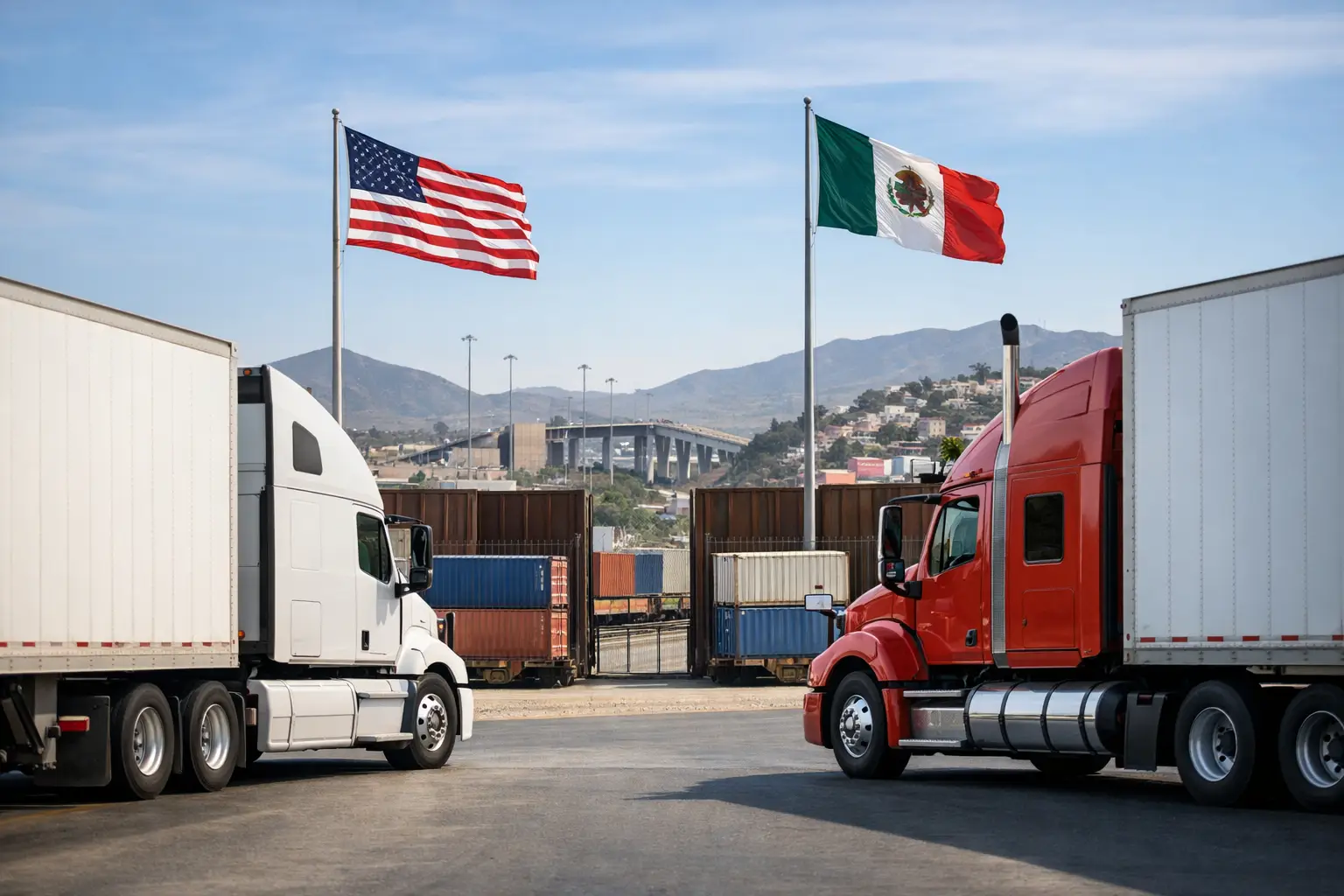
A trailer can reach Laredo on schedule and still lose a full shift at the border because the commercial invoice shows an incomplete description, the consignee data does not match the entry, or the Mexican pedimento is not ready. This cross border shipping guide is built for the point where freight plans become border execution: documents, filings, handoffs, inspections, and final-mile delivery.
For US-Mexico freight, transit time is not just a carrier metric. It is the combined performance of the shipper, importer of record, exporter, customs broker, drayage provider, carrier, warehouse, and customs authorities. When those parties work from separate emails and incomplete data, a small documentation issue becomes detention, missed appointments, and production risk.
Cross Border Shipping Guide: Start With Ownership
Before booking a truck, establish who owns each obligation. This is not administrative cleanup. It determines who supplies product data, pays duties and taxes, approves declarations, resolves holds, and receives delivery notices.
For every lane, document the importer of record in the destination country, exporter of record where applicable, broker of record, commercial terms, delivery point, and party responsible for freight charges. Incoterms can clarify cost and risk allocation, but they do not replace a customs operating plan. A term such as DDP may assign broad responsibility to the seller, yet the team still needs to confirm who can legally act as importer, provide tax registration details, and authorize the customs filing.
US-bound freight requires accurate entry information for Customs and Border Protection. Mexico-bound freight requires the correct customs process, including a pedimento where required, through a properly authorized Mexican customs operation. The exact requirements depend on the commodity, transaction value, origin, regulatory agencies, and mode. Do not treat a prior shipment as proof that the next one is compliant. Part numbers, suppliers, country of origin, and program eligibility can change the answer.
Build the Shipment File Before the Truck Is Dispatched
The border does not reward last-minute document collection. The customs team needs a complete, consistent shipment file early enough to classify goods, validate values, identify restrictions, and submit entries before the freight reaches the crossing.
At a minimum, the commercial invoice and packing list must agree on quantities, product descriptions, values, weights, units of measure, shipper, consignee, and country of origin. Vague descriptions such as “auto parts,” “samples,” or “machinery” create friction because they do not describe what the product is, what it does, or what it is made of. Use descriptions that support classification and agency review, such as “stamped steel automotive seat recliner component” or “polypropylene injection-molded storage container.”
Classification and valuation deserve a formal review process. The Harmonized Tariff Schedule classification drives duty treatment and can trigger additional requirements. Declared value must reflect the actual transaction and any additions required under applicable customs valuation rules. A low invoice value may look like a cost-saving measure, but it can create audits, penalties, and shipment holds that cost far more than the duty exposure.
Origin claims require the same discipline. A product made in Mexico is not automatically eligible for preferential treatment under the United States-Mexico-Canada Agreement. Eligibility depends on the product-specific rules of origin and supporting records. Keep origin determinations, supplier certifications, bills of materials, and classification decisions accessible. Customs questions often arrive after delivery, not only at the crossing.
Some products need additional documents or agency clearance. Food, cosmetics, medical devices, chemicals, wood products, textiles, alcohol, and regulated electronics are common examples. This is where commodity-specific planning matters. The right answer is not to add paperwork blindly. It is to identify the applicable agency, registration, permit, label, or data element before freight is tendered.
Design the Border Handoff, Not Just the Linehaul
A US-Mexico shipment is often two transportation moves joined by a border transfer. The northbound or southbound linehaul carrier may not be the carrier performing the cross-border drayage, and the trailer or cargo may be transferred in a yard before another carrier takes possession. That handoff is where visibility usually breaks.
Map the physical sequence for each lane: origin pickup, export staging, broker document review, crossing, inspection contingency, import release, yard transfer or transload, destination linehaul, and final delivery. Then assign one accountable party for status updates and exception management.
The required operating controls are straightforward, but they must be active:
- A cutoff for receiving complete documents before arrival at the border
- A validated shipment reference that follows the freight, filing, and carrier dispatch
- Named contacts for broker escalation, carrier dispatch, warehouse receiving, and importer approval
- Predefined actions for inspections, missing documents, rejected entries, and delivery appointment changes
- Arrival, release, departure, and delivery milestones visible to the team that owns the customer or production outcome
A crossing plan should also account for hours, lane capacity, holidays on both sides of the border, equipment availability, and destination appointment windows. A truck can clear customs quickly and still miss the operational objective if the receiving facility is closed or the domestic carrier has no capacity after release.
Treat Customs Data as Operating Data
The best customs process is not a separate compliance task completed after transportation is planned. It is part of shipment control. The product master, purchase order, invoice, carrier reference, and customs filing should draw from the same verified facts.
That does not mean every team needs another portal or a major system implementation. It means information must enter the process once, be extracted accurately, and be available to the people filing entries and moving freight. Email attachments, PDFs, spreadsheets, and supplier invoices remain common in cross-border operations. The risk is not the format itself. The risk is manual rekeying across multiple disconnected providers.
Automation can reduce that risk when it captures invoice data, flags missing fields, compares documents, and routes exceptions to an operator before submission. It should not be treated as a substitute for broker judgment. Classification questions, origin analysis, valuation issues, and regulated commodities still require qualified review. The practical model is automation for repetitive intake and validation, with experienced operators controlling exceptions and accountability.
For ocean freight entering the United States, importers must also account for Importer Security Filing requirements. ISF is a separate pre-arrival obligation and should not be confused with a truck shipment’s CBP entry process. If your supply chain combines ocean, rail, and truck legs, document the filing responsibilities for every mode instead of assuming the broker handling the final delivery owns them all.
Measure What Actually Causes Delay
Many teams track only estimated time of arrival and total transit days. Those metrics are useful, but they hide the source of border friction. Track the operational events that can be improved.
Start with document-ready time: how long before border arrival did the broker receive a complete, usable file? Then track entry acceptance, release time, inspection frequency, exception reason, drayage dwell, transfer time, and delivery performance against appointment. Separate customs holds from carrier capacity issues and warehouse delays. Otherwise, every late shipment gets labeled a “border problem,” and nothing changes.
Use exceptions to improve the upstream process. If descriptions repeatedly need correction, fix the invoice template or supplier instructions. If origin support is missing, build a supplier certification cadence. If freight is released but sits in a yard, redesign the post-release handoff. Repeated delays are usually a process design failure, not bad luck.
Choose Partners Based on Accountability
The cheapest quote can be expensive when it creates four separate escalation paths. A broker may clear the entry, a drayage provider may move the freight across, a carrier may handle final delivery, and a warehouse may control the next available appointment. That model can work for simple, low-volume shipments with an experienced internal team. It becomes fragile when volume rises, freight is time-sensitive, or multiple facilities depend on predictable border flow.
Ask prospective providers how they manage a rejected entry at 3 p.m., a secondary inspection, or a trailer released after the final destination cutoff. Ask who sees the documents first, who communicates release status, and who owns the delivery recovery plan. The answers should identify people, milestones, and a workflow - not vague assurances.
For high-volume US-Mexico operations, BorderFlow combines customs orchestration, licensed brokerage, cross-border trucking, and execution visibility in one workflow. The purpose is simple: fewer handoffs, fewer manual touches, and one accountable operating layer from origin through final delivery.
The border will always require documentation, authority review, and contingency planning. What changes performance is whether your operation discovers problems at the crossing or controls them before the truck arrives. Build the workflow around that distinction, and the border becomes a managed checkpoint instead of a daily source of surprises.