
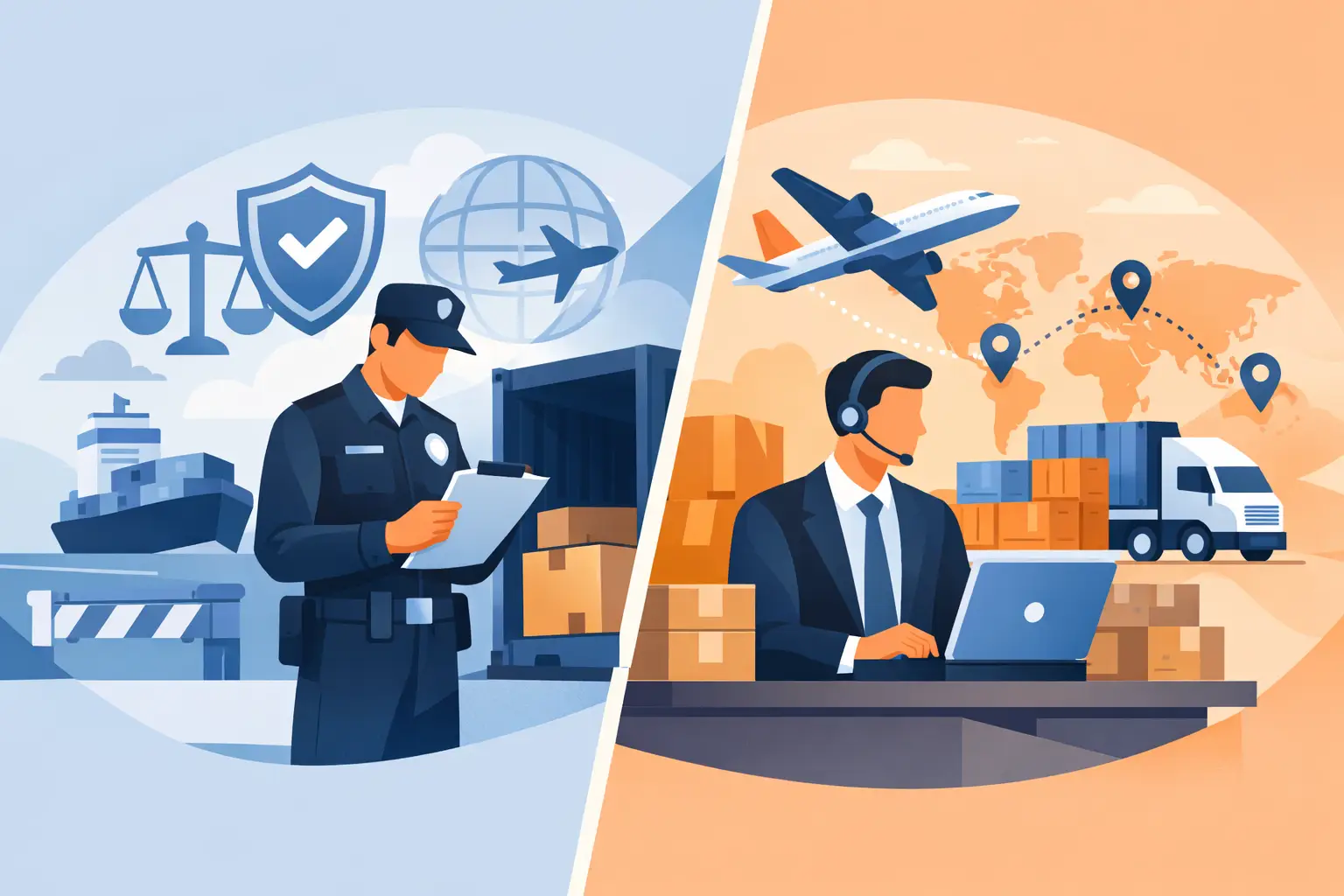
A truck can arrive at the border on time and still miss its delivery window because the commercial invoice does not match the shipment, a classification is incomplete, or a release was never confirmed. That is the operational difference behind the customs broker vs freight forwarder question: one party manages regulatory clearance, while the other organizes freight movement. For US-Mexico shippers, treating those roles as interchangeable creates expensive handoffs.
Customs broker vs freight forwarder: the core difference
A customs broker is a licensed representative that prepares and submits customs entries, works with government agencies, and supports compliant import or export clearance. In the United States, a customs broker operates under a license issued by U.S. Customs and Border Protection. Their work centers on entry data, tariff classification, valuation, country of origin, duty and tax calculation, admissibility requirements, and communication with CBP and partner government agencies.
A freight forwarder organizes the physical movement of cargo. That may include selecting carriers, coordinating pickup and delivery appointments, booking linehaul capacity, arranging drayage, consolidating LTL shipments, managing bills of lading, and tracking freight through transit. A forwarder may move freight under its own transportation arrangements or coordinate a network of carriers and providers.
The distinction is simple on paper: brokers clear goods; forwarders move goods. In real cross-border operations, the two workflows are tightly connected. A customs entry cannot be filed correctly without accurate commercial documents and shipment details. A carrier cannot cross efficiently if release status, border routing, and handoff timing are unclear.
What a customs broker actually handles
A broker’s primary job is to make sure an import is declared correctly and presented to customs in a form that can be processed. The broker receives shipment documents, validates the data, prepares the entry, transmits it to the appropriate customs system, and monitors release or requests for more information.
For a US import, that commonly includes the commercial invoice, packing list, bill of lading or air waybill, importer information, Harmonized Tariff Schedule classification, declared value, country of origin, and any applicable product-specific requirements. Depending on the commodity, the broker may also coordinate data required by agencies such as the FDA, USDA, EPA, DOT, or CPSC.
For ocean imports into the United States, a broker or another authorized filing party may also support Importer Security Filing requirements. For freight entering Mexico, the clearance process involves Mexican customs documentation, including the pedimento, and coordination with the appropriate licensed customs representative.
A broker can identify missing data, flag potential compliance issues, and help establish repeatable classification and entry processes. But the importer of record remains responsible for the accuracy of the declaration, duty payment, and compliance with applicable laws. A broker reduces execution risk. It does not transfer the importer’s legal responsibility away.
That distinction matters when a product description is vague, an invoice value is inconsistent, or a supplier changes a component without telling the customs team. The entry may be filed by the broker, but the underlying facts must come from the importer and its supply chain.
What a freight forwarder actually handles
A freight forwarder turns a shipment requirement into a transportation plan. The work begins before the truck is dispatched: freight dimensions, pickup readiness, equipment needs, commodity restrictions, delivery appointments, route constraints, and service expectations all affect the plan.
For US-Mexico freight, a forwarder may coordinate origin pickup in Mexico, Mexican domestic transport, export-side staging, cross-border linehaul, US drayage, and final delivery. The scope can also include carrier procurement, freight consolidation, status updates, proof of delivery, and exception management when a truck is delayed or freight is not ready.
Forwarders are particularly valuable when a shipper needs to manage multiple transportation legs without separately coordinating every carrier. They can give the transportation plan a single owner. However, not every forwarder is a customs broker, and not every broker arranges transportation.
There is another distinction worth making: a carrier physically operates the truck, rail service, vessel, or aircraft. A forwarder may arrange that capacity, but it may not own the equipment or employ the driver. Knowing who is responsible for each leg prevents confusion when freight is late, damaged, held, or misrouted.
Why the distinction gets blurred at the US-Mexico border
Cross-border freight does not move in a clean sequence where transportation ends and customs begins. Documents often arrive while freight is already moving. A release issue can change a carrier’s border plan. A missed transfer appointment can turn a customs-ready shipment into a storage or detention problem.
Consider an LTL shipment moving from Monterrey to a distribution center in Texas. The forwarder may arrange pickup, linehaul, cross-dock handling, and final-mile delivery. The customs broker prepares the export and import documentation needed for the border process. If the invoice is corrected after the truck is dispatched, both teams need the update immediately. If they work in disconnected systems, the carrier may arrive with old paperwork while the broker is working from a revised version.
That is where fragmented vendor management fails. The issue is not whether a broker or forwarder is more valuable. It is whether the customs data, freight status, and border execution are connected well enough to prevent a handoff from becoming a delay.
Laredo is a clear example of this pressure. High shipment volume, drayage coordination, carrier queues, customs release timing, and facility appointments all converge in a tight operating window. A team that learns about a document exception after the truck has reached the border has already lost control of the move.
When you need a broker, a forwarder, or both
You need a customs broker when you are importing or exporting goods that require formal customs handling and you need qualified support for entry preparation, filing, classification, duty treatment, or agency requirements. Even experienced import teams use brokers because the compliance work is specialized and time-sensitive.
You need a freight forwarder when you need help planning and managing the movement itself, especially across multiple carriers, modes, facilities, or countries. This is often the right fit for shippers without dedicated transportation capacity, as well as teams managing fluctuating volume or complex delivery schedules.
Most cross-border shippers need both capabilities. The practical decision is whether to source them separately or operate them through one coordinated workflow.
Separate providers can work well when volume is low, lanes are stable, and the shipper has a strong internal team that owns document control and exception management. It can also make sense when a company has a preferred transportation provider and a specialized broker for a highly regulated product category.
The trade-off is accountability. When a shipment is held, the broker may be waiting on corrected documents, the forwarder may be waiting on release, the carrier may be waiting for dispatch instructions, and the warehouse may be waiting for an updated ETA. Each party can be doing its job while no one owns the full outcome.
What to look for in a cross-border partner
The better question is not simply, “Do you provide brokerage and forwarding?” Ask how the operational handoff works. Can the team see the same document version? Does customs release status flow directly into transportation execution? Who alerts the shipper when a classification issue threatens a pickup or border crossing? Who owns the exception through final delivery?
For repeat US-Mexico lanes, technology matters when it removes work rather than creating another system to manage. Document intake, data extraction, classification support, entry preparation, shipment visibility, and dispatch coordination should operate from the same source of truth. No portal. No login. No change to your workflow is useful only if the underlying process is actually connected.
BorderFlow is built around that operating model: customs execution and cross-border freight coordination in one workflow, supported by technology that can process customs documents directly from email. The goal is not to make shippers think like customs brokers or dispatchers. It is to give their team a clear status, faster exception response, and one accountable owner for the move.
The operating model matters more than the label
A customs broker and freight forwarder solve different problems, and both are necessary in many supply chains. The broker protects the clearance process. The forwarder protects the movement plan. At the border, those protections only work when the data and the decisions move together.
Build your process around the moment a shipment goes wrong, not the moment a quote is issued. If your team can immediately identify the document owner, freight owner, release status, next action, and final delivery impact, you have a workable border operation. If it takes four calls to find out who is handling the problem, the shipment is already carrying too much risk.