
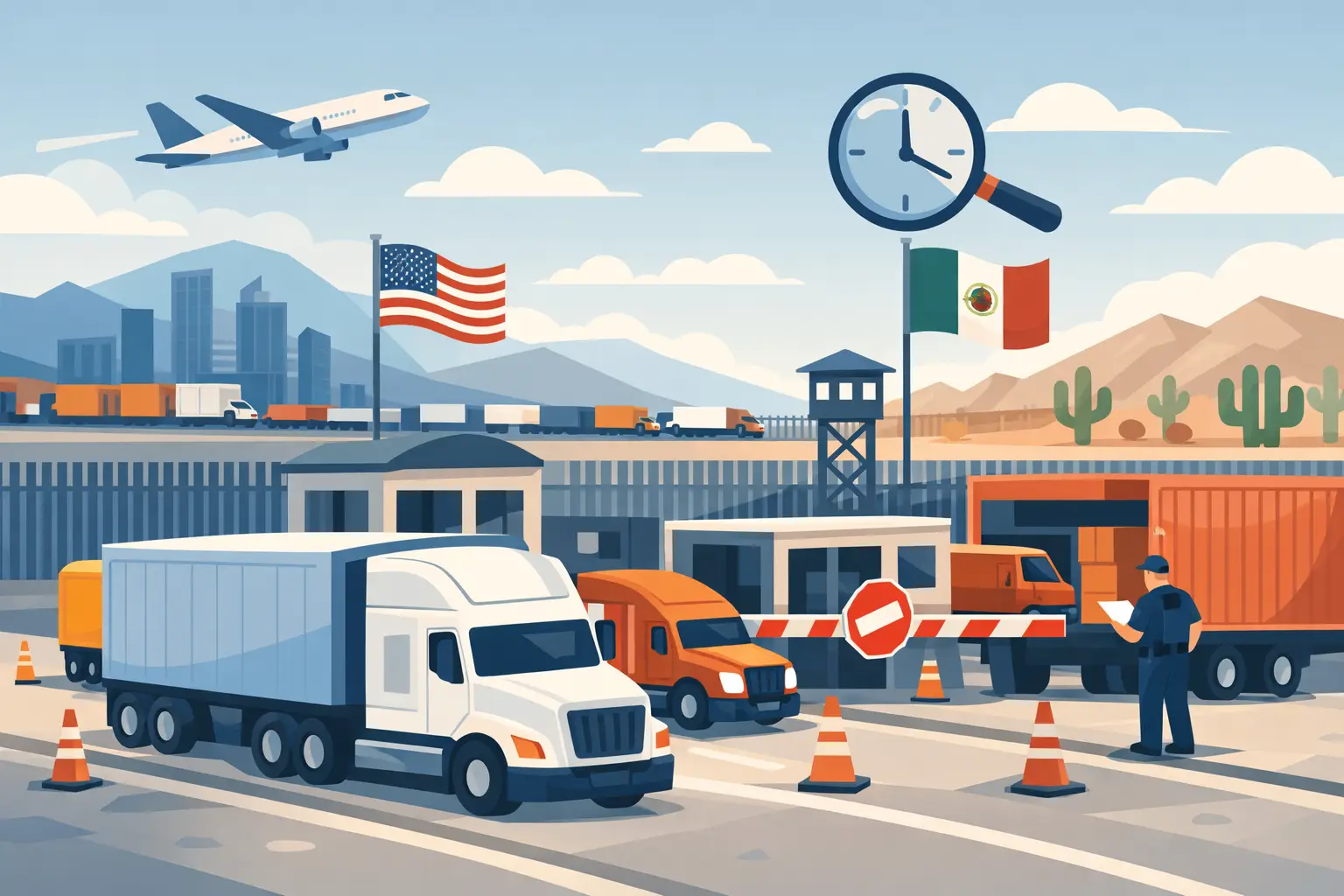
A truck can arrive at the port with a confirmed pickup, a driver in position, and a delivery appointment waiting on the other side - then lose six hours because one field on a commercial invoice does not match the entry data. That is the reality behind the top causes of border delays. Most are not caused by the physical crossing itself. They begin earlier, in disconnected workflows, late documents, bad master data, and unclear ownership.
For US-Mexico shippers, border performance is not a single carrier metric or a broker metric. It is the output of a chain: commercial documents, tariff classification, customs filing, carrier dispatch, drayage coordination, inspections, and final-mile execution. A weak handoff anywhere in that chain can stop the entire move.
Top Causes of Border Delays: Document Failures
Documentation is the most common source of avoidable border friction because customs entries depend on data that often originates in ERP systems, supplier emails, spreadsheets, and shipping offices. By the time a broker receives it, the freight may already be headed toward the border.
A commercial invoice with an incomplete consignee address, inconsistent quantities, missing country of origin, or unclear product description can trigger rework. So can a packing list that does not align with the invoice, a bill of lading with the wrong shipment reference, or a document packet that arrives after the carrier has been dispatched.
The problem is not merely missing paperwork. It is document consistency. Customs teams need the invoice, packing list, transportation data, and entry details to tell the same story. When they do not, someone has to stop, investigate, correct, and resubmit. At a busy crossing, that correction cycle can turn a manageable issue into a missed delivery window.
The operating control is simple in principle: collect documents early, validate required fields before the truck is released, and maintain a single shipment record that every party can reference. In practice, this requires automation and a defined exception process. Email-based document intake can work well, provided the data is extracted, checked, and routed fast enough to act before cutoff.
Classification, Valuation, and Compliance Errors
An inaccurate HTS classification, a weak product description, or an incorrect declared value creates more risk than a late document. These errors can lead to entry rejection, holds, requests for additional information, penalties, or post-entry exposure.
Classification is especially difficult for manufacturers moving mixed loads, engineered components, electronics, automotive parts, machinery, and products with changing bills of material. A description such as “parts” or “components” may be acceptable to an internal shipping team, but it does not provide the detail needed to support a customs decision. Customs authorities need to understand what the product is, what it is made of, what it does, and how it is used.
Valuation issues also surface when related-party transactions, assists, royalties, transfer pricing adjustments, or freight allocations are handled inconsistently. The fastest crossing strategy is never to file first and clean up later. Speed without defensible data is exposure.
A better approach is to treat classification and valuation as controlled master data, not shipment-by-shipment guesswork. Establish approved classifications for recurring SKUs, document the reasoning behind them, and create escalation rules for new or changed products. That reduces both filing time and compliance risk.
Late or Incorrect Customs Filings
Freight cannot clear on a schedule if the entry is not ready when the truck reaches the border. Yet late filing remains common when the broker receives final documents only after loading, the carrier changes equipment or driver information, or the shipper assumes a prior shipment’s data can simply be copied forward.
For U.S.-bound ocean freight, an Importer Security Filing issue can create problems long before cargo reaches the land border. For over-the-road US-Mexico freight, entry timing, PACS or ACE data integrity, and the coordination of Mexican pedimentos all matter. The exact requirements vary by mode, commodity, importer profile, and direction of travel, but the operational rule does not: filing readiness must be confirmed before the freight is in the queue.
Incorrect filings are equally disruptive. A transposed invoice number, inaccurate quantity, mismatch between entry and manifest data, or a last-minute change to the load can prevent release until the record is corrected. If the shipment has multiple vendors or invoices, the risk compounds.
The strongest teams use a pre-border release gate. Before dispatch, they confirm that documents are complete, the entry or pedimento is prepared, transportation references are correct, and any missing data has a named owner and deadline. A shipment should not become a border emergency because no one checked filing status at origin.
Inspections and Government Holds
Not every delay is preventable. CBP, Mexican customs authorities, and partner government agencies can select freight for inspection based on targeting criteria, commodity risk, importer history, random selection, or data anomalies. An inspection does not automatically indicate wrongdoing, but it changes the operating plan immediately.
The mistake is treating inspection as a black-box event. Shippers need visibility into where the freight is, what agency is involved, what information is required, and who is responsible for the next action. Without that, the carrier waits, the warehouse loses labor planning, and customer service receives vague updates with no recovery path.
Preparation helps. Accurate descriptions, complete documents, compliant packaging, and consistent classifications reduce preventable questions. But no broker or carrier can guarantee that a shipment will never be inspected. The practical goal is faster response: get the requested documents, product details, photographs, certificates, or corrections to the right party without another round of internal handoffs.
Carrier, Drayage, and Yard Coordination Gaps
Customs clearance and transportation execution are often managed by different vendors with different systems. That fragmentation creates a familiar failure pattern: the broker says the freight is released, but the driver has not been notified; the carrier arrives before documents are ready; drayage capacity is unavailable after inspection; or the truck clears too late to make its delivery appointment.
At high-volume crossings such as Laredo, minutes matter because queues, bridge traffic, yard capacity, and driver hours can shift throughout the day. A release message alone is not an execution plan. The transport team needs a live view of the shipment’s customs status, truck status, border position, and downstream appointment requirements.
This is where a single accountable workflow changes the outcome. When brokerage, carrier dispatch, drayage, and delivery coordination operate from disconnected inboxes, every exception becomes a phone-tree exercise. When they operate from the same shipment record, the release can trigger the next action automatically and exceptions can be assigned before they become dwell time.
Border Congestion and Timing Constraints
Some delays are physical. Bridge congestion, weather, road closures, holiday volumes, staffing constraints, and heavy seasonal surges can lengthen crossing times even when every document is correct. The border is a capacity-constrained operating environment, not a predictable conveyor belt.
These constraints require planning rather than blame. Shippers should build realistic transit assumptions by crossing, lane, day of week, time of day, commodity, and inspection history. A lane that performs well on a Tuesday morning may behave very differently near a holiday weekend or during a production surge.
There is also a trade-off between speed and cost. Premium capacity, alternative routing, earlier pickups, and buffer inventory can protect service levels, but they may raise transportation or inventory costs. The right choice depends on the cost of a missed line-side delivery, a warehouse shutdown, or a customer stockout.
How to Reduce Border Delays Through Better Control
The best prevention strategy is not more status emails. It is a controlled pre-border workflow with clear ownership. Every shipment should have validated documents, confirmed classifications, ready customs filings, verified transportation data, and an exception owner before it approaches the crossing.
That requires technology, but not technology for its own sake. The useful systems are the ones that remove manual rekeying, extract data from the documents teams already send, flag mismatches early, and make customs and transportation status visible in one place. No portal. No login. No change to your workflow should not mean less control. It should mean the control happens behind the scenes without forcing operators into another disconnected process.
Border delays are rarely solved at the bridge. They are prevented by making the right decision while the freight is still at the plant, warehouse, or supplier dock - when there is time to correct the record, protect the schedule, and keep the border from becoming the first place a problem is discovered.