
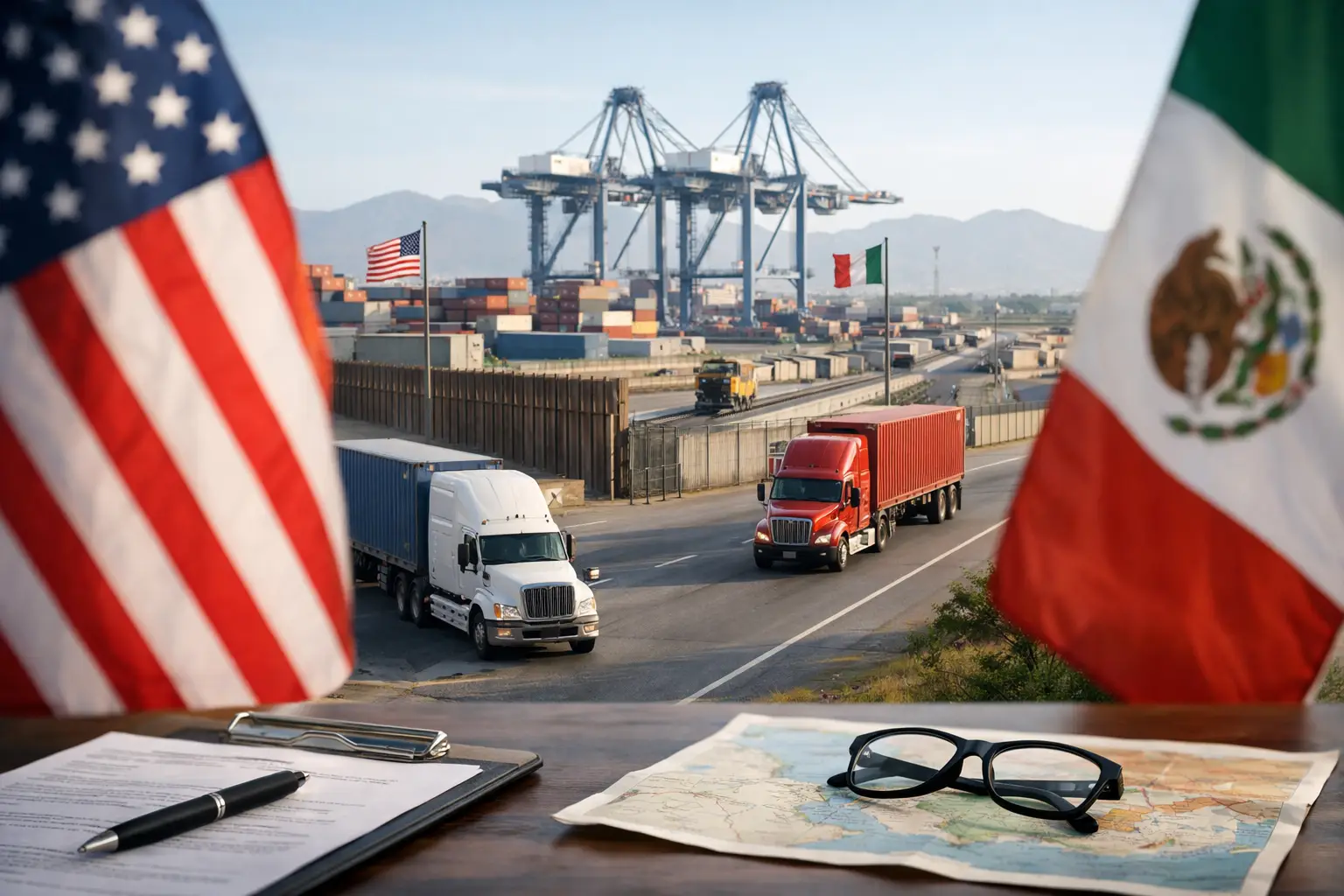
A US Mexico trade compliance guide is most useful when it starts where shipments fail: not at the border, but upstream in the data, documents, and handoffs that determine whether a load can clear. A truck arriving in Laredo with an incomplete commercial invoice, mismatched quantities, or an unsupported tariff classification is already late. The border is simply where the failure becomes visible.
For high-volume shippers, compliance is not a paperwork function sitting outside transportation. It is an operating system for moving freight predictably. The objective is clear: get the same commercial, product, valuation, and party data to every required filing, on the correct side of the border, before the freight reaches the crossing.
Start With the Correct Import Model
Every shipment needs a defined importer of record, customs broker, carrier, and document owner for both the U.S. and Mexico legs. Those roles cannot be assumed from the transportation plan. A U.S. consignee may be the importer of record for a northbound move, while a Mexican entity with the required tax registration and importer authorization handles a southbound import. The commercial arrangement, Incoterm, and title transfer point influence the setup, but they do not replace customs responsibility.
On the U.S. side, the importer of record is responsible for reasonable care, including entry accuracy, classification, value, country of origin, admissibility, and recordkeeping. A customs broker files entries, but the importer retains the underlying compliance obligation.
On the Mexico side, the importer must generally be properly registered to import and able to support the pedimento filed through its customs representative. Mexico-specific requirements can vary by product, sector, importer profile, and trade program. Do not treat a Mexican import as a mirror image of a U.S. entry. It is a separate customs process with separate data and compliance controls.
Before the first load moves, document who owns each action: product classification, origin determination, invoice approval, broker instructions, duty payment, permit review, and post-entry correction. If ownership is spread across procurement, finance, logistics, and a plant team, establish one accountable escalation path. Border delays often come from a team waiting for another team to answer a question no one formally owns.
Classification Is the Control Point
A product description such as “metal parts” or “electronic components” is not customs-ready data. Brokers need enough technical detail to determine the appropriate classification, evaluate admissibility, and support the declared value and origin. That means material composition, function, manufacturing process, dimensions where relevant, part numbers, and intended use.
The United States uses the Harmonized Tariff Schedule of the United States. Mexico applies its own tariff schedule and may require additional product-level detail, including NICO identifiers. The first six digits of a Harmonized System classification are often aligned internationally, but the full national classification can differ. A U.S. HTS code should not be copied into a Mexican filing without validation.
Classification affects more than duty. It can determine whether a product is subject to antidumping or countervailing duties, partner government agency requirements, labeling rules, quotas, special Mexico sector controls, or a licensing requirement. It also shapes the data used in origin analysis under the United States-Mexico-Canada Agreement, or USMCA.
Build a governed product master rather than letting each shipment team recreate classifications from email. At minimum, keep approved U.S. and Mexico classifications, product descriptions, origin data, bill of materials references where needed, valuation method, and any required permits or certifications tied to the SKU. Change control matters. A supplier material change can alter classification or origin even when the internal part number stays the same.
Treat USMCA Origin as a Product Decision
USMCA can reduce or eliminate duty on qualifying goods, but shipping from Mexico does not automatically make a product eligible. Origin depends on the applicable rule of origin, which may require a tariff shift, regional value content calculation, specific production process, or a combination of tests.
The practical risk is not just paying duty when you could have claimed a preference. It is claiming preferential treatment without support. A certificate of origin is not a magic document. The importer, exporter, or producer must have records that substantiate the claim, and U.S. Customs and Border Protection can verify it.
Run origin qualification at the product level, especially for goods assembled in Mexico from globally sourced inputs. Maintain supplier origin statements, bill of materials, classifications for non-originating materials, production records, and calculations where the rule requires them. Review the file when sourcing changes, suppliers change, engineering modifies a component, or a new manufacturing location comes online.
There is a trade-off here. A broad, supplier-issued declaration may be faster to collect, but a product-level qualification file is more defensible when volumes, duty exposure, or audit risk are significant. High-volume programs should design for repeatability, not one-off certificate chasing.
Build Documents From a Single Source of Truth
The commercial invoice is the foundation for both customs processing and freight execution. It should identify the buyer and seller, importer and consignee when different, detailed goods description, quantity, unit price, total value, currency, country of origin, Incoterm, and terms of sale. It must align with the packing list, purchase order, broker instructions, and electronic shipment data.
Small discrepancies create large exceptions. A quantity on the invoice that differs from the packing list can stop a pedimento review. A declared unit value that does not reconcile with the purchase order can trigger a valuation question. A part number described differently by the shipper, broker, and carrier can turn a routine crossing into a manual investigation.
For Mexico imports, electronic documentation and required customs data must be prepared in the format and timing required for the entry process. For U.S. imports, the entry data and supporting documents must be available before filing and retained afterward. Ocean shipments also require Importer Security Filing, or ISF, before loading at the foreign port for cargo bound to the United States. ISF is not a border form, but a late or inaccurate filing can create penalties and operational friction long before the container reaches its destination.
The strongest workflow captures documents once, extracts the relevant data, validates it against product and party master data, then distributes the approved information to customs and transportation teams. This is where automation earns its place. It should eliminate rekeying and flag exceptions, not conceal decisions that require a qualified customs review.
Coordinate the Border as One Operating Sequence
A compliant shipment can still miss its delivery window when customs, drayage, carrier dispatch, and warehouse receiving work from different versions of the plan. Northbound freight may require export processing in Mexico, U.S. entry preparation, crossing coordination, release confirmation, and onward carrier dispatch. Southbound freight has its own order of operations and often a different set of timing constraints.
The key is pre-clearance discipline. Brokers should receive complete, validated documents early enough to review classification, value, origin, and admissibility before dispatch. Carriers need correct reference numbers and crossing instructions. The receiving site needs realistic release and arrival visibility, not an assumed appointment based on a truck’s departure time.
Use exception rules that force action before a truck reaches the border. Examples include missing importer data, invoice values outside tolerance, new part numbers without approved classifications, origin claims without supporting records, or a load tendered without a complete document package. The goal is not to create more holds. It is to move holds upstream, where they are cheaper and faster to resolve.
For shippers managing multiple providers, this is often the hidden cost of fragmentation. One party sees the documents, another sees the truck, another files the entry, and no one owns the outcome. A unified workflow gives operations one view of freight status and customs status, with a clear person responsible for the next action. BorderFlow is built around that operating model: customs execution, freight coordination, and document automation in one accountable flow.
Maintain Records for the Question That Comes Later
Release is not the end of compliance. U.S. importers must generally keep required entry records for five years from the date of entry. Mexico also has recordkeeping obligations that should be confirmed against the importer’s specific operations and tax requirements. Keep records in a form that can be retrieved by shipment, entry, SKU, supplier, and origin claim.
A useful post-entry review compares what was filed with what actually happened commercially. Review classification changes, value adjustments, assists, rebates, royalties, returns, repairs, shortages, and supplier credits. Some issues require corrections or formal post-entry action; the correct response depends on the facts and timing. Bring customs counsel or a qualified broker into material exposure decisions early rather than treating an audit notice as the starting point.
Track recurring exceptions, not just penalties. If the same supplier repeatedly sends incomplete invoices or the same plant releases loads before documents are approved, that is a process defect with measurable border cost. Fixing the source process is more effective than asking the broker to work around it load after load.
The next shipment is the best place to test your controls. Take one active lane, trace its data from purchase order through final delivery, and identify every place a person rekeys, interprets, or waits for information. That map will show whether your compliance program is controlling the move or merely reacting when the freight reaches the border.