
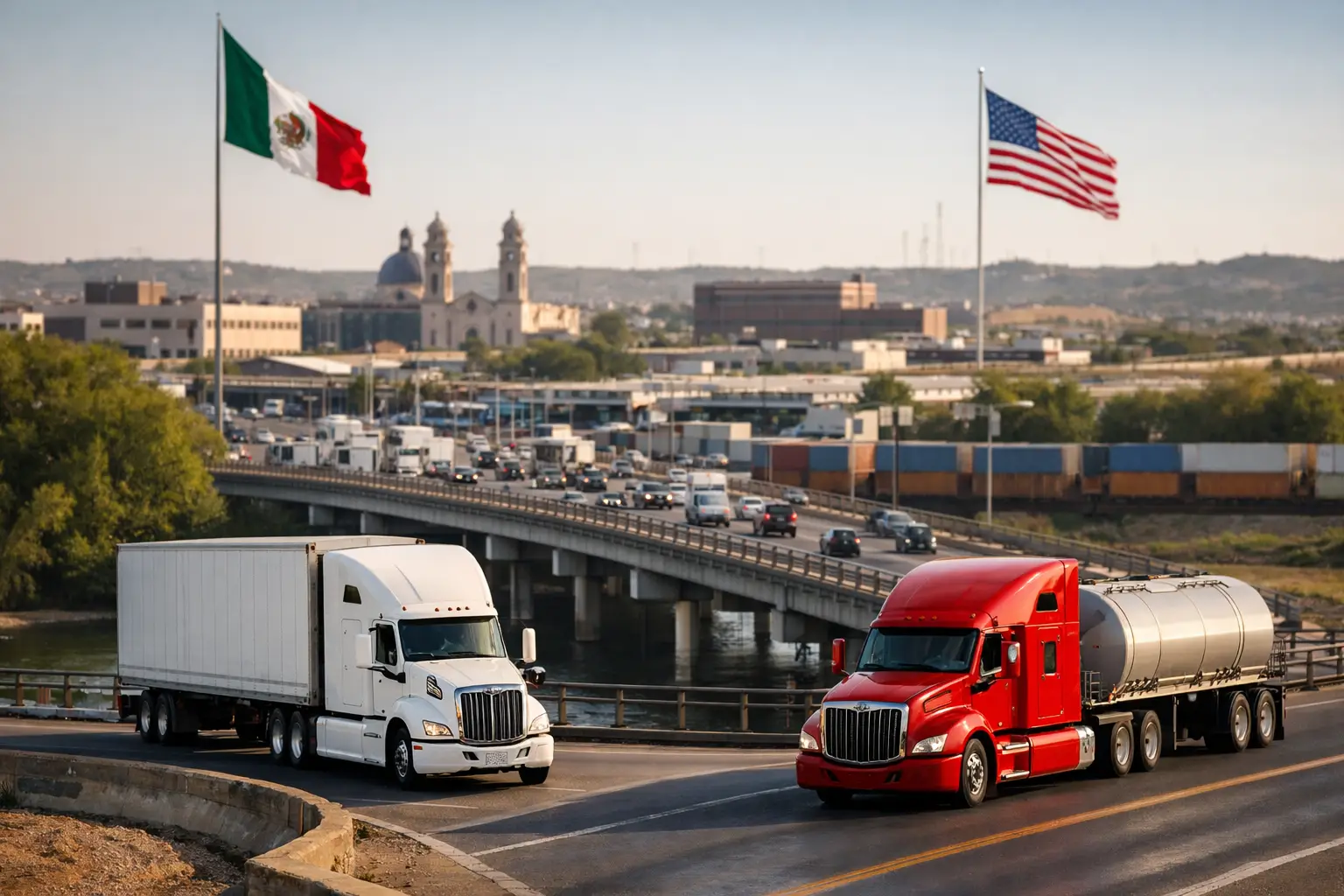
A truck can leave Monterrey on schedule, clear the industrial corridor cleanly, and still lose half a day if the Laredo handoff is poorly managed. That is why Laredo matters so much in cross-border operations. For shippers moving serious volume between Mexico and the United States, this is not just another gateway on a map. It is the place where customs execution, drayage coordination, trailer strategy, and communication discipline all show up at once.
If your team treats Laredo like a simple crossing point, you usually pay for it in dwell, missed appointments, rework, and avoidable escalation. If you treat it like an operating system with tight dependencies, freight moves faster and problems surface sooner.
Why Laredo matters more than most gateways
Laredo handles an enormous share of US-Mexico over-the-road trade, which means its importance is structural, not temporary. The market has dense carrier capacity, established drayage networks, warehouse infrastructure, customs coverage, and a deep bench of service providers on both sides of the border. That concentration creates opportunity, but it also creates congestion and complexity.
For importers and logistics teams, Laredo is attractive because it offers scale. There are more routing options, more transload and yard capacity, more brokerage activity, and more chances to recover a shipment when something goes wrong. But scale cuts both ways. When a port is this important, small execution errors get amplified quickly. A missing commercial invoice, a bad HTS classification, a trailer mismatch, or a late arrival into staging can ripple across the whole move.
That is why experienced operators do not think about Laredo as a location alone. They think about it as a control point.
The real work in Laredo starts before the truck arrives
Border delays are often blamed on traffic or inspections, but many of the worst failures start upstream. By the time freight reaches the border, the margin for fixing paperwork problems is already thin.
A clean Laredo move depends on early document control, accurate shipment data, and aligned timing across shipper, carrier, customs broker, and receiving facility. If any one of those parties is working from stale or incomplete information, the border becomes the place where the issue finally becomes visible.
That is why strong operators front-load the process. Commercial invoices, packing lists, shipper instructions, product data, importer records, routing details, and security filings all need to be validated before the linehaul leg is committed. The goal is simple: when the truck gets to Laredo, nobody should be trying to figure out what the freight is.
What usually breaks in a Laredo freight move
Most border teams have seen the same pattern. The shipment itself is ready, but the workflow around it is fragmented.
One provider handles linehaul in Mexico. Another handles drayage. A separate customs broker files the US entry. Someone else is responsible for the pedimento. The warehouse has its own timing constraints. The consignee wants updates, but no one owns the full sequence. In that model, Laredo turns into a handoff chain, and handoff chains fail under pressure.
The most common breakdowns are operational, not theoretical. Documents arrive late or in the wrong format. Customs data is rekeyed manually and introduces errors. The carrier reaches the border without confirmation that the entry is actually ready. The drayage appointment does not match warehouse receiving windows. One party knows there is a hold, while everyone else is still assuming the shipment is moving.
None of this is unusual. The problem is that too many teams still accept it as normal.
Customs friction is usually a data problem
When teams talk about customs delays, they often talk as if customs were the only variable. In reality, customs friction in Laredo is frequently a data quality issue. If the declared product description is vague, if values do not reconcile, if the importer data is incomplete, or if the filing is built from unverified documents, you are creating exposure before the truck even reaches the bridge.
Good brokerage matters, but brokerage without disciplined intake is still fragile. Speed at the border comes from getting the filing right early, not from trying to fix it after arrival.
Transportation friction is usually a coordination problem
Not every delay is a customs delay. Sometimes the entry is fine and the transportation plan is not. Trailer availability, cross-dock timing, bonded movements, driver scheduling, equipment positioning, and final-mile appointments all need to line up. In Laredo, where freight volumes are heavy and turnaround pressure is constant, weak coordination shows up fast.
This is especially true for shippers running just-in-time programs, high-SKU consumer goods, automotive supply, electronics, or any lane where appointment failure creates downstream production or retail risk.
How strong operators manage Laredo differently
The best-performing cross-border teams do a few things consistently.
First, they unify execution. That does not always mean one company performs every service internally, but it does mean one workflow governs the move. Customs, drayage, transfer, and final delivery cannot operate as disconnected tasks if the shipment is time-sensitive.
Second, they reduce manual rework. If your team is still forwarding emails between brokers, carriers, and warehouses while someone retypes invoice data into multiple systems, Laredo will expose that weakness. Border operations reward clean data flow and punish fragmented communication.
Third, they manage exceptions by clock, not by inbox. A hold, mismatch, missing document, or arrival shift needs immediate visibility because each hour affects trailer planning, labor scheduling, and customer commitments. The later an exception gets surfaced, the more expensive it becomes.
Laredo is where visibility either proves itself or fails
A lot of logistics teams say they have visibility because they can track a truck. That is not enough for border freight.
In Laredo, real visibility means knowing whether customs documents have been received, whether entry data has been validated, whether release status has changed, whether drayage is confirmed, whether the trailer has transferred, and whether the shipment is still aligned to delivery timing. Map dots are useful, but they do not prevent border failures.
This is one reason more shippers are moving away from disconnected brokers and point solutions. They do not need another dashboard that sits beside the work. They need the workflow itself to produce visibility as the shipment moves.
For operators moving high volume through Laredo, that difference matters. Visibility should not be a reporting layer added after the fact. It should be built into execution.
When Laredo is the right choice and when it depends
Laredo is the default gateway for many northbound and southbound truck moves for good reason. It offers density, infrastructure, and familiarity across the trade community. If your freight originates in major industrial regions in northeastern or central Mexico and moves into Texas or deeper into the US network, Laredo often makes operational sense.
But the right routing still depends on freight profile, destination, service level, and risk tolerance. Some shippers benefit from alternate border strategies when capacity tightens, when inland delivery commitments shift, or when commodity-specific requirements make another routing more practical. Laredo is powerful, but it is not automatically correct for every load.
The key is to make the routing decision as part of a broader operating plan, not as a habit. Border strategy should be driven by lane economics, compliance requirements, transit expectations, and recovery options when something goes sideways.
What a modern Laredo workflow should look like
A strong cross-border operation through Laredo is not flashy. It is controlled.
The shipment data is captured early. Documents are ingested without forcing the customer into a new portal or a new process. Customs review begins before arrival pressure builds. Transportation milestones are tied to release status. Drayage, transfer, and final-mile planning sit inside one coordinated sequence. When there is an exception, the right party sees it immediately and acts on it.
That operating model is not about adding more software layers. It is about reducing handoff gaps. For teams that move freight every day, the win is straightforward: fewer delays, less manual chasing, better compliance control, and tighter predictability at the border.
BorderFlow was built around that reality because the problem at Laredo is rarely a lack of effort. It is usually too many parties working from different systems, different timelines, and different versions of the truth.
Laredo will stay central to US-Mexico freight because the market needs a gateway that can handle volume at industrial scale. The real question is not whether your freight will pass through it. The question is whether your operation is built to control what happens there.