
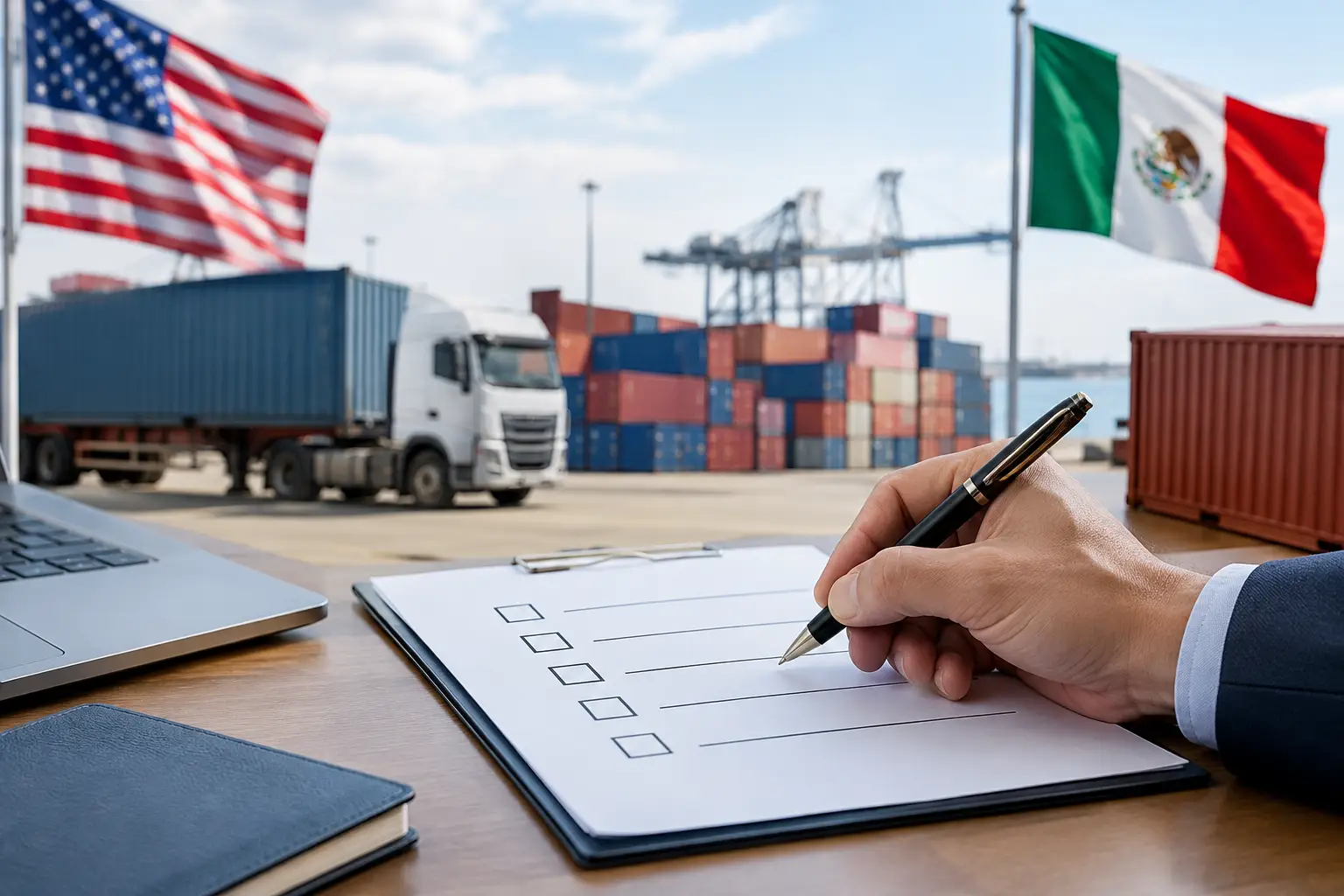
A truck can be loaded, dispatched, and sitting within miles of the border before a preventable data error stops it cold. This customs compliance risks checklist is built for teams moving freight between Mexico and the United States that need to find issues before the shipment reaches the port, not after CBP, ANAM, or a broker asks questions.
The real exposure is rarely one missing field. It is the handoff chain: commercial invoice data entered by one team, classification owned by another, transportation arranged by a third party, and customs documents reviewed too late to fix without affecting delivery. A controlled pre-shipment process turns those handoffs into accountable checks.
Start With a Customs Compliance Risks Checklist
Use this checklist at the shipment level, but support it with a product-level review process. Some checks belong on every load. Others, such as tariff classification or special program eligibility, must be validated whenever a product, supplier, manufacturing process, or transaction structure changes.
1. Confirm the importer and party roles
Start with the legal entities. Confirm the importer of record in the United States, the importer in Mexico where applicable, exporter, manufacturer, seller, consignee, and ultimate consignee. Make sure the names, addresses, tax identifiers, and registration details match the commercial documents and entry instructions.
This becomes especially important in related-party transactions, virtual import structures, IMMEX operations, and shipments where goods move through a third-party warehouse. The company physically receiving the freight is not automatically the party responsible for customs obligations. If the role assignment is unclear, duty liability, recordkeeping responsibility, and broker instructions can all be wrong.
2. Validate classification before freight is tendered
HS classification drives duty treatment, admissibility requirements, government agency flags, and trade remedy exposure. A classification copied from an old invoice, a supplier spreadsheet, or a customer purchase order is not a classification process.
Review the product description against what the product actually is, how it functions, its materials, and its technical specifications. Retain the reasoning and supporting records. For US imports, confirm the HTSUS number. For Mexico, validate the applicable TIGIE classification and the data required for the pedimento.
Classification risk rises when an item is a kit, an assembly, a replacement part, a chemical, an electrical component, or a product with changing content. It also rises when engineering modifies a bill of materials without notifying customs or logistics. A one-digit error can create a correction. A materially wrong classification can create duty underpayments, penalties, and a pattern of entries that require cleanup.
3. Test origin claims, not just origin labels
Country of origin is not always the country of shipment or the supplier's location. Review where the goods were produced and whether processing in Mexico, the United States, or another country changed origin under the applicable rules.
If the shipment will claim preferential tariff treatment under USMCA, maintain the analysis behind that claim. A blanket supplier statement is not enough if it lacks product-level support, uses outdated rules, or does not reflect current sourcing. Confirm that the certifier has a reasonable basis, the product-specific rule of origin is met, and the certification data is complete and traceable.
There is a commercial trade-off here. Claiming preference can reduce duty, but weak substantiation creates audit exposure that can outweigh the savings. For high-volume lanes, treat origin validation as a controlled data set, not a document collected at the last minute.
4. Reconcile customs value and invoice terms
Customs value must reflect the transaction and the applicable valuation rules, not simply the number most convenient for billing. Check the price actually paid or payable, currency, Incoterms, assists, royalties, commissions, packing costs, freight treatment, and any additions or deductions that apply.
Related-party pricing deserves additional scrutiny. A transfer price accepted for income tax purposes does not automatically resolve customs valuation. Likewise, provisional pricing, year-end adjustments, free-of-charge materials, tooling, and customer-supplied components can affect declared value.
The commercial invoice should tell a coherent story: who sold the goods, what was sold, in what quantity, for what value, and under which delivery terms. When invoice data conflicts with a purchase order, packing list, or broker entry, stop and resolve the mismatch before filing.
5. Check the document set for consistency
Customs clearance depends on consistent data across documents. Before pickup or dispatch, compare the commercial invoice, packing list, bill of lading or carrier details, purchase order, entry instructions, certificates, permits, and prior shipment references where relevant.
Check part numbers, units of measure, quantities, weights, country of origin, values, currency, marks and numbers, and package counts. Small discrepancies can generate holds because they create doubt about what is actually on the truck.
For Mexico-bound freight, confirm that the data required to prepare the pedimento is complete and available early enough for review. For US-bound ocean freight, confirm ISF responsibilities and timing well before vessel loading. For truck freight, ensure the carrier, driver, trailer, and crossing details can be tied to the customs filing without manual guesswork.
6. Screen for admissibility and regulatory controls
Not every product can move with a standard customs entry. Depending on the goods, other agencies and rules may apply, including FDA, EPA, USDA, DOT, FCC, alcohol and tobacco controls, textile labeling, wood packaging requirements, or product-specific standards.
Also screen for antidumping and countervailing duties, Section 232 or Section 301 exposure where applicable, quotas, embargoes, restricted parties, and export controls. These issues are often missed because the product itself seems routine. A steel-containing component, a chemical input, or a dual-use electronic item can trigger requirements that do not appear in a basic shipping workflow.
Do not assume a previous clearance proves admissibility. Product composition, country of origin, supplier, and enforcement priorities can change. When the consequence of being wrong is a detention, seizure, or material duty assessment, escalation is faster than a border delay.
7. Confirm packaging, marking, and physical freight controls
The physical shipment must match the declared shipment. Confirm country-of-origin marking where required, carton labels, product labels, wood packaging compliance, seal controls, and the package count loaded onto the equipment.
For cross-border trucking, inspect how the freight is loaded and documented before the trailer is sealed. A damaged seal, unrecorded transfer, mixed freight with unclear segregation, or incorrect trailer number can force a rework at exactly the moment the load should be crossing.
This is also where customs and transportation operations meet. A compliant entry with the wrong driver information, unconfirmed crossing, or unavailable trailer is not an executable border move.
8. Establish a correction and escalation path
Errors happen. The risk is not the existence of an error but the absence of a controlled response. Define who can approve a document correction, who contacts the supplier, who instructs the broker, and when a shipment must be held instead of pushed toward the border.
Keep an audit trail of changes, including the original data, corrected data, reason for the change, and the party who approved it. This protects the importer during internal reviews and gives operations a way to identify recurring failures by supplier, plant, product, or lane.
A practical rule: if a correction changes classification, origin, value, quantity, or the identity of a party to the transaction, treat it as a customs event, not a clerical edit.
Make the Checklist Part of the Freight Workflow
A checklist buried in a shared folder will not protect a high-volume operation. The controls need to sit where work happens: email intake, document capture, product master data, brokerage review, carrier dispatch, and exception management.
That does not require forcing every supplier or warehouse onto a new portal. It requires extracting the right data early, validating it against rules and historical records, then routing exceptions to people who can resolve them. BorderFlow applies that operational model across customs filing and cross-border execution, reducing the gaps between document intake, entry preparation, and truck movement.
Measure the process with operating metrics, not just clearance outcomes. Track document-ready time, entries corrected before filing, post-entry corrections, border holds by root cause, supplier error rates, and dwell time caused by customs exceptions. A load that clears eventually may still have exposed a weak process.
When to Escalate Beyond the Checklist
A checklist is a control layer, not a substitute for customs counsel, a binding ruling, or a technical classification analysis. Escalate when the shipment involves a new product, uncertain origin, related-party value, changing manufacturing, a trade remedy concern, government agency requirements, or a material correction to past entries.
The best time to solve a compliance question is while the freight is still at the plant and the technical team is available. Once a trailer is queued for the bridge, every unanswered question becomes more expensive. Build the discipline upstream, and the border becomes a scheduled operating step rather than a daily point of failure.