
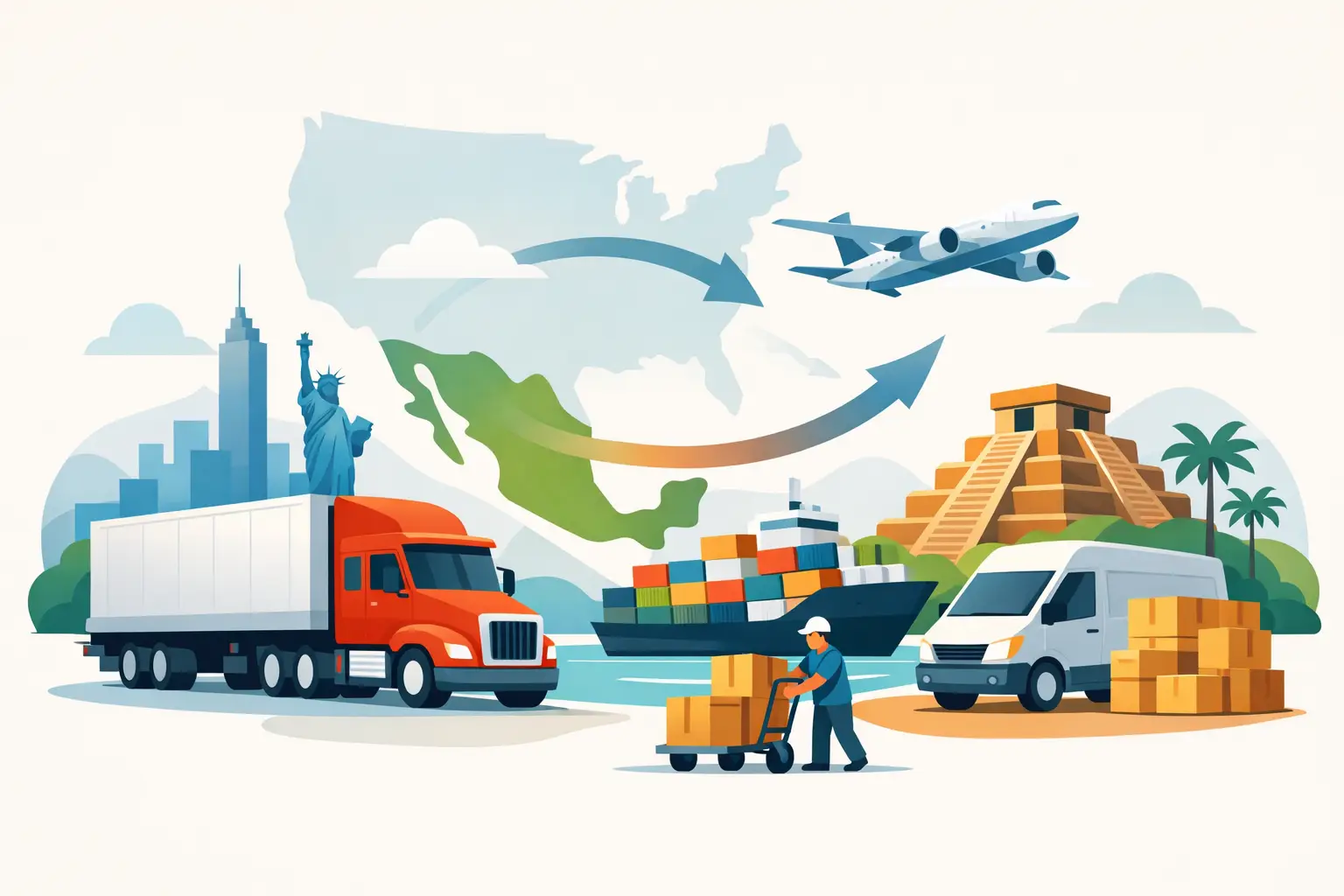
A truck is loaded in Monterrey at 9:00 a.m. By noon, the shipper has sent the commercial invoice, packing list, and pickup details to one provider. By the next morning, the freight is already moving through a coordinated border plan instead of sitting in a handoff gap between carrier, broker, and drayage. That is what door to door Mexico freight is supposed to look like.
Too often, it does not. The phrase sounds simple, but cross-border execution rarely is. What many providers call door-to-door is really a chain of separate services stitched together after the fact - domestic pickup in Mexico, export handling, border drayage, US entry filing, transload or trailer swap, and final-mile delivery. When those pieces are managed by different companies with different systems, delays usually show up at the exact point where accountability disappears.
What door to door Mexico freight really includes
In practical terms, door to door Mexico freight means one coordinated move from the shipper's facility in Mexico to the consignee's location in the United States, or the reverse. That includes linehaul planning, customs documentation, border crossing strategy, carrier coordination, and final delivery scheduling.
The problem is that many shippers buy this service expecting a single workflow, then discover they are still chasing multiple parties for updates. One broker handles the pedimento. Another files the US entry. A drayage carrier moves the load across the bridge. A warehouse handles transfer. A separate truck delivers inland. Each step may be functional on its own, but the shipment still behaves like a fragmented move.
A true door-to-door model puts those steps under one operating plan. That does not mean every asset is owned by one company. It means the shipment is managed as one job, with one data flow, one document intake process, and one accountable team.
Why cross-border freight breaks at the handoff
Most border delays are not caused by the physical crossing alone. They happen because information arrives late, documents do not match, classification is incomplete, or the next carrier is waiting on a release nobody clearly owns.
That matters because the US-Mexico border is not a single event. It is a sequence. Pickup timing affects export readiness. Export readiness affects drayage scheduling. Drayage scheduling affects customs timing. Customs timing affects transfer appointments and final delivery windows. If one party is operating off stale information, the entire move slips.
This is where door to door Mexico freight earns its value. Not by using a broad promise, but by reducing the number of handoffs where freight and data can drift apart.
The operating model that works
The best cross-border setups are boring in the right way. They are structured, repeatable, and controlled.
A strong process starts before the truck arrives at origin. Commercial documents are reviewed early. Product data is validated before filing deadlines become urgent. Pickup instructions, commodity details, and importer data are tied to the shipment before it reaches the border. If the load requires special handling - bonded movement, transload, temperature control, hazmat review, or a specific bridge strategy - those decisions are made upstream, not in a panic at the port.
Once the freight is moving, transportation and customs should operate inside the same workflow. That is the difference between visibility and actual control. Visibility tells you where a problem is. Control gives you the ability to prevent it or reroute around it.
For high-volume shippers, that usually means centralizing document intake, standardizing classification logic, and using one execution layer across FTL and LTL moves. No portal. No login. No forcing the customer to rebuild their internal process just to get a shipment across the border.
Door to door Mexico freight for FTL and LTL
FTL and LTL do not fail for the same reasons, so they should not be managed the same way.
With FTL, the main pressure points are border timing, trailer strategy, equipment availability, and appointment integrity on both ends. A missed customs window or bridge delay can ripple through a plant schedule or a distribution center unload. Door-to-door FTL works best when the provider can align customs filing, drayage, and final delivery against a single schedule rather than treating each step as a separate dispatch problem.
LTL is more sensitive to document quality and consolidation timing. One data error can hold freight that would otherwise move quickly. Transit can also vary more depending on terminal networks, transfer points, and border handling methods. For LTL, operational discipline matters even more because the margin for correction is smaller once freight enters a shared network.
Shippers moving both modes should push for a unified process, not separate playbooks. Different service logic is fine. Different accountability is not.
Customs is not a side task
A lot of transportation providers still treat customs as an external dependency. That is a mistake.
On US-Mexico freight, customs is part of movement design. Product classification, valuation support, importer data, admissibility review, and pedimento preparation all affect whether the truck moves on schedule. If customs is handled in a separate lane from transportation, the shipment may look booked but still not be operationally ready.
That is why integrated customs execution matters. When document intake, data extraction, classification, and entry submission are tied directly to the shipment workflow, teams spend less time forwarding PDFs and reconciling mismatched details across email threads. The result is faster filing, fewer preventable holds, and a cleaner chain of custody for information.
For operators managing repetitive cross-border volume, automation has a direct impact here. Not because software replaces expertise, but because it removes the manual drag from repetitive tasks that slow down broker and transportation teams alike.
What to ask a provider before you hand over freight
If you are evaluating door to door Mexico freight providers, the right questions are operational. Ask who controls pickup in Mexico, who files on both sides of the border, how drayage is coordinated, how exceptions are surfaced, and who owns communication when a load misses plan.
Also ask how documents enter the workflow. If the process depends on manual rekeying across multiple systems, expect more errors and slower response times. If every party has a different status feed, expect conflicting updates. If nobody can show exactly when the shipment became customs-ready, expect finger-pointing when transit slips.
The strongest providers can explain their workflow in sequence, from origin tender to final proof of delivery. They can tell you where the risk points are, what data they need upstream, and how they handle exceptions without turning your team into the control tower.
When one provider is better - and when it depends
For most recurring freight between Mexico and the US, one coordinated provider is the cleaner model. It reduces vendor sprawl, shortens communication loops, and creates one layer of accountability across customs and transportation.
That said, it depends on your network. Some large shippers already have deeply negotiated domestic capacity, in-house trade compliance teams, or fixed warehouse transfer models they do not want to change. In those cases, a hybrid structure can still work if the process owner is clear and the systems are aligned.
But hybrid only works when someone is actually orchestrating it. If the shipper is left to reconcile broker messages, drayage updates, and inland carrier ETAs manually, then the operational cost is just being pushed upstream onto the customer.
The real value is control, not just coverage
Anyone can promise pickup in Mexico and delivery in the US. The harder part is maintaining control across the moments where cross-border freight usually stalls - document intake, customs readiness, bridge coordination, and final delivery handoff.
That is where operator-led execution matters. In markets like Laredo, where border volume and timing pressure are constant, small process failures get exposed fast. The providers that perform consistently are the ones built around workflow discipline, customs fluency, and fast exception handling, not just carrier access.
Door-to-door service is only useful when it removes complexity from your side of the desk. If it still takes three calls and six emails to find out why a shipment has not crossed, you do not have a door-to-door solution. You have a marketing label.
The better standard is simple: one shipment, one workflow, one accountable team. That is how cross-border freight moves faster, cleaner, and with fewer surprises.