
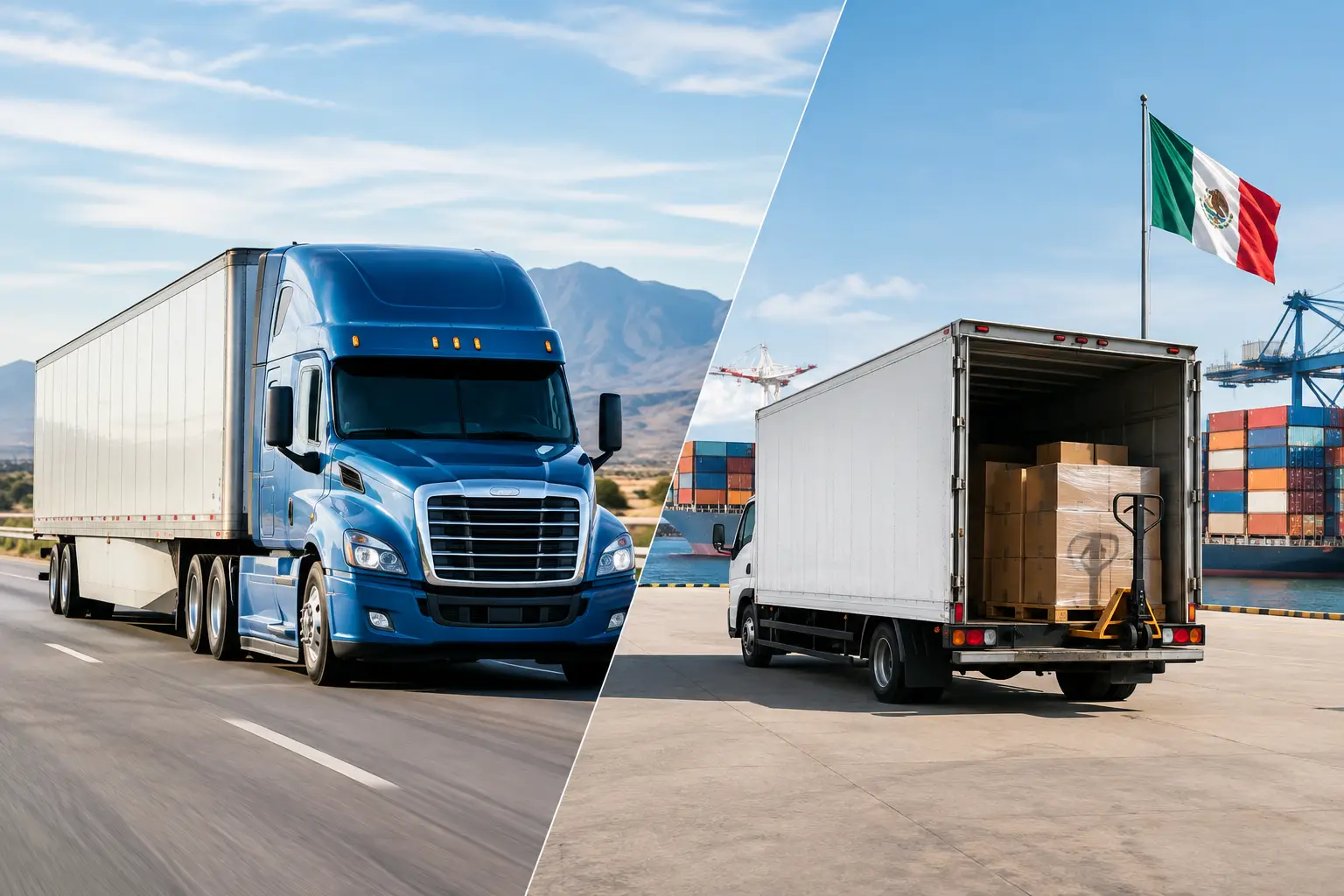
A truck leaving Monterrey for a U.S. distribution center can look simple on a rate sheet. It is not simple once freight reaches the border. The FTL versus LTL Mexico decision changes more than transportation cost. It affects pickup control, cargo handling, customs readiness, border dwell time, delivery appointments, and who owns the exceptions when the move stops moving.
For cross-border operators, the right question is not whether full truckload or less-than-truckload is cheaper. The question is which mode gives the shipment the right balance of speed, cost, security, and execution control.
FTL Versus LTL Mexico: The Operating Difference
Full truckload, or FTL, reserves most or all of a trailer for one shipper’s freight. The truck normally picks up at origin and moves directly toward the consignee, with limited handling before delivery. On a US-Mexico lane, the equipment, driver, or trailer may change at the border depending on the carrier network and operating model. But the cargo remains a dedicated load.
Less-than-truckload, or LTL, combines multiple shippers’ freight into a shared network. A pallet may move through origin terminals, consolidation points, border facilities, transfer locations, and destination terminals before final delivery. That network structure makes LTL economical for smaller shipments, but every additional touchpoint adds a potential delay or damage exposure.
Neither mode is automatically better. A six-pallet shipment with a flexible delivery window may be an efficient LTL move. The same six pallets can justify FTL when they are production-critical, difficult to handle, high-value, or heading to a location where a missed appointment creates a larger cost than the truck rate.
When FTL Is the Better Mexico Freight Option
FTL earns its higher cost when control matters more than shared-network efficiency. It is usually the better fit for freight that can fill a trailer, freight that must move on a specific schedule, or freight where handling risk is unacceptable.
A dedicated truck reduces the number of cargo touches. That matters for fragile components, regulated goods, temperature-sensitive freight, and loads with packaging that does not tolerate repeated dock handling. It also gives transportation teams greater control over loading sequence, seal integrity, pickup timing, and delivery appointments.
FTL can also simplify customs coordination. A single shipper, a single commercial document set, and one clear loading plan are easier to validate than a consolidated trailer carrying unrelated shipments. Simplified does not mean automatic. Classification, valuation, admissibility, and supporting documents still need to be correct before the truck arrives. But the operational chain has fewer parties waiting on each other.
Dedicated capacity is particularly valuable for automotive, industrial manufacturing, electronics, and replenishment freight moving between Mexican production sites and U.S. plants or distribution centers. If a plant needs a component at 6 a.m. Monday, an LTL terminal cycle is rarely the risk most operators want to take.
FTL is not always faster in a meaningful way. A poorly prepared full truckload can sit at the border just as long as any other shipment. Missing invoices, incorrect data, incomplete partner government agency requirements, or late entry filing can erase the advantage of a direct truck. The trailer type does not solve a document problem.
When LTL Makes More Sense
LTL is designed for shipments that do not need dedicated equipment. If a shipper is moving a few pallets or a partial load and can accept a broader pickup and delivery window, shared capacity can lower spend substantially versus paying for unused trailer space.
This is common for aftermarket parts, lower-volume replenishment, samples, non-urgent finished goods, and recurring orders that can be planned around a carrier’s service schedule. LTL can be especially effective when freight is properly palletized, stackable, accurately classified, and ready before the carrier cutoff.
The trade-off is network dependency. Transit estimates can include terminal processing, consolidation, border transfer, customs release, deconsolidation, and final-mile scheduling. A shipment that is physically close to its destination may still wait for the next linehaul departure or delivery route.
LTL also requires tighter discipline around packaging and data. Freight is handled more often, so pallets need to be stable, labeled, and protected for forklift movement and cross-dock environments. Dimensions, weight, commodity descriptions, and freight class must match reality. Bad shipment data can create reweighs, reclassifications, accessorial charges, or a delay while the carrier resolves an exception.
For Mexico cross-border LTL, ask a direct question before booking: where will the freight consolidate, clear customs, transfer, and deconsolidate? A provider that cannot explain the physical and customs workflow is giving you a rate, not an operating plan.
Cost Is More Than the Linehaul Rate
The usual comparison starts with price per shipment. That is necessary, but it is incomplete. FTL pricing is driven by lane, equipment, capacity conditions, fuel, border crossing strategy, and urgency. LTL pricing depends on weight, dimensions, density, freight class, accessorials, origin and destination service points, and network routing.
The better comparison is landed transportation cost: the rate plus every operational cost created by the mode. For FTL, that can include detention, layover, equipment mismatch, expedited recovery, or an empty trailer waiting on a late load. For LTL, it can include liftgate service, limited-access delivery, residential or appointment fees, reclassification charges, storage, and the cost of freight arriving after a required date.
A lower LTL quote is not a savings if a late pallet forces a production line to stop. Likewise, a dedicated truck is not disciplined planning if it leaves with a small shipment every week because orders were never consolidated. The right answer depends on the cost of failure, not just the cost of transportation.
Customs Timing Changes the FTL-LTL Decision
Customs is often treated as a separate workstream from transportation. On US-Mexico freight, that separation creates avoidable failures. Freight mode, carrier cutoff, document collection, entry preparation, broker communication, and border arrival need to operate as one sequence.
With FTL, the cutoff is often tied to a scheduled pickup and crossing plan. The customs team needs commercial invoices, packing details, product data, and any required compliance information early enough to identify issues before the truck is loaded or dispatched. Waiting until the driver is near the port of entry turns a correctable data issue into detention.
With LTL, timing can be even less forgiving because the shipment must meet the carrier’s consolidation schedule. Missing paperwork may cause a pallet to miss a trailer, remain at a terminal, or move without the expected service level. If a consolidated load contains freight for multiple importers, one unresolved exception can create operational friction for everyone involved.
The strongest cross-border process creates one shipment record that connects the freight details, customs documents, status milestones, and accountable parties. BorderFlow applies this model through a unified workflow for trucking and customs execution, so teams are not reconciling disconnected updates from brokers, carriers, and drayage providers after the fact.
A Practical Way to Choose
Start with shipment characteristics, then test the operational consequences. FTL is generally the stronger choice when the load is near trailer capacity, delivery is time-critical, the product is high-value or damage-sensitive, or a missed date creates material business disruption. It is also often the right call when a shipper needs direct control over pickup, loading, and delivery timing.
LTL is generally the better choice when the freight is palletized, smaller, flexible on transit, and inexpensive enough that shared handling does not create unacceptable risk. It works best when shipment data is clean and the operating team understands the provider’s terminal and border process.
There is also a middle ground. Partial truckload, consolidation programs, scheduled milk runs, and planned pool distribution can reduce unused FTL capacity without accepting every limitation of standard LTL. These options require consistent volume and good forecasting, but they can outperform both one-off FTL and ad hoc LTL for repeat lanes.
Do Not Let the Mode Create a Handoff Problem
The common failure is not choosing FTL or LTL. It is assigning transportation, customs, documents, and delivery communication to separate parties with no shared accountability. When a shipment is delayed, each vendor can point to the next handoff while the consignee waits.
Build the shipment plan before freight is tendered. Confirm the commodity data, document readiness, equipment requirements, pickup window, broker instructions, crossing plan, and final delivery constraints. Then select the mode that supports that plan rather than the lowest rate that appears first.
A well-run cross-border move should make the border a controlled operating step, not a black box. Choose FTL when dedicated control protects the business. Choose LTL when shared capacity truly fits the shipment. In either case, get the data and accountability in place before the freight starts rolling.