
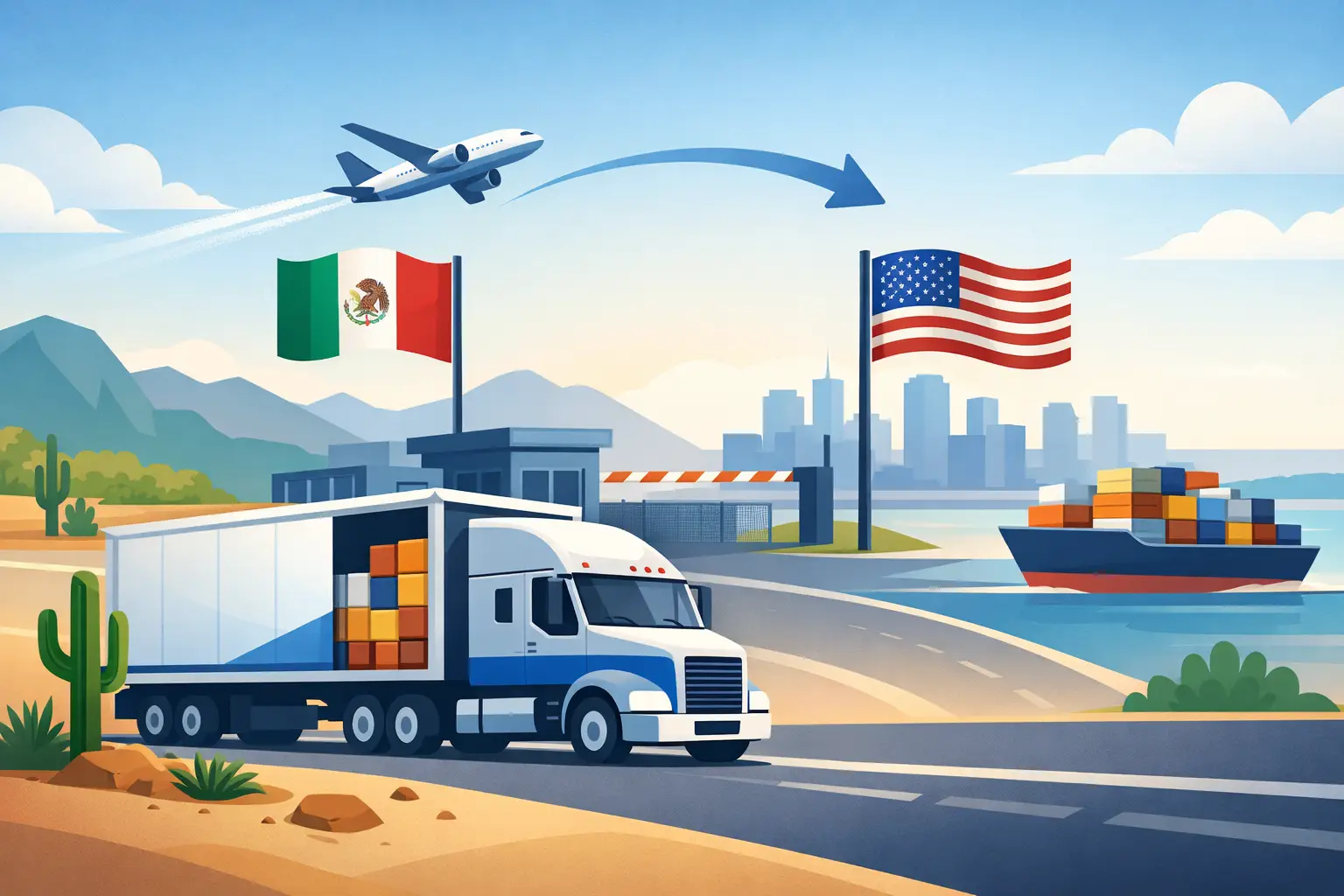
A late pallet rarely starts as a trucking problem. In cross-border freight, the delay usually shows up earlier - bad commercial invoice data, missing broker documents, a handoff nobody owns, or a trailer sitting at the border waiting for the next party to respond. That is why ltl shipping mexico to us is less about booking space and more about controlling the workflow from pickup through customs clearance and final delivery.
For importers and logistics teams, LTL across the border can be the right move when shipment sizes do not justify a full truckload, but it comes with tighter coordination risk. More parties touch the freight. Consolidation adds timing variables. Customs errors affect multiple downstream steps. If the process is fragmented, cost savings from LTL disappear fast.
How LTL shipping Mexico to US actually works
At a high level, cross-border LTL starts the same way as any domestic LTL move: freight is picked up, sorted, linehauled, and delivered through a shared-capacity network. The difference is that a US-Mexico move adds export handling in Mexico, border transfer planning, customs entry into the United States, and often drayage between facilities or yards before the freight joins a domestic delivery leg.
That matters because the shipment is not moving through one continuous carrier network in the way many shippers expect. In many cases, the freight moves through a chain of parties with separate responsibilities. A Mexican carrier handles origin pickup. A customs broker manages pedimento and export data. A drayage provider or cross-border carrier handles the border crossing. A US customs broker files entry with CBP. Then a US carrier completes final delivery.
Any break in that chain creates idle time. With LTL, that risk is amplified because palletized freight is often scheduled around terminal cutoffs, consolidation windows, and transfer appointments. Miss one document deadline and the freight may not just be delayed a few hours. It may miss the entire next movement cycle.
Why cross-border LTL breaks down
The most common problem is not lack of capacity. It is lack of orchestration.
When shippers manage separate brokers, carriers, drayage partners, and warehouses, each party sees only one slice of the move. The carrier may know the pickup is complete but not whether the customs packet is clean. The customs broker may be waiting on invoice corrections while the warehouse assumes the freight is already cleared. Operations teams then start chasing status through email threads and phone calls instead of moving freight.
Document quality is another major failure point. LTL freight often moves fast enough that teams rely on manual forwarding of invoices, packing lists, HTS classifications, and shipper instructions. If those documents are incomplete or inconsistent, customs review slows down immediately. Product descriptions that are too vague, mismatched values, wrong consignee data, or missing manufacturer information can all force rework.
There is also a cost trade-off that gets missed in planning. LTL is usually chosen to avoid paying for unused trailer space, which makes sense. But if the shipment is highly time-sensitive, multi-stop, or prone to customs complexity, the cheapest transportation mode on paper can become the most expensive operationally. Demurrage, storage, missed production windows, and labor spent chasing exceptions add up quickly.
When LTL shipping Mexico to US makes sense
LTL is a good fit when the freight is palletized, does not require dedicated equipment, and can tolerate the additional transfer points that come with shared-capacity moves. It is especially useful for replenishment freight, recurring plant-to-DC shipments, aftermarket parts, and regular cross-border lanes where products and customs data stay consistent.
It is less ideal for highly fragile freight, cargo with irregular dimensions, urgent line-down shipments, or loads with documentation that changes every time. Those moves can still ship LTL, but the margin for error is much smaller.
A practical test is simple: if the shipment can handle one more touch, one more checkpoint, and one more scheduling dependency without hurting the business, LTL is probably viable. If not, paying more for tighter control may be the better decision.
The operational model that reduces border friction
The cleanest cross-border LTL moves run in one controlled workflow. Pickup, export documentation, Mexican customs handling, border transfer, CBP entry filing, and final mile delivery should all be connected operationally, even if multiple physical assets are involved.
That does not mean every shipment needs one carrier doing everything. It means one accountable operator should manage every step, with shared visibility into shipment status, document readiness, and customs milestones.
This is where most import programs improve the fastest. Not through a dramatic network redesign, but by removing handoff gaps.
If your team is forwarding paperwork to one broker, calling another party for drayage, then waiting for a domestic LTL carrier update after the freight crosses, you are relying on coordination by inbox. That is fragile by design. A unified process gives your operations team one execution thread instead of five.
What to control before the freight reaches the border
Most border delays are preventable before pickup even happens. Shipment data needs to be complete, consistent, and usable by both transportation and customs teams.
The commercial invoice should match the physical shipment and include product descriptions that support classification. Quantities, values, units of measure, Incoterms, manufacturer information, and consignee details should be validated early. If the load requires special handling, that instruction should move with the booking, not appear after the freight is already in motion.
For repeat freight, standardization matters even more. If the same SKUs ship every week from the same supplier in Mexico to the same US facility, there is no reason for customs documentation to be rebuilt manually each time. Repetitive document handling introduces unnecessary variation. Strong operators automate intake and validation so the shipment can move without waiting on someone to rekey data from PDFs and email attachments.
That is one reason software matters in cross-border LTL, but only if it reduces work instead of creating another system to manage. The best setups automate classification support, document extraction, and entry preparation inside the existing communication flow. No portal. No login. No change to your workflow.
Border execution is where accountability shows
At the border, speed comes from preparation. By the time the freight reaches transfer, the filing strategy should already be clear, documents should already be in order, and the drayage or crossing plan should already be aligned with the downstream delivery schedule.
This is especially important in high-volume corridors such as Laredo, where throughput is strong but timing discipline matters. A missed cutoff, incomplete packet, or unclear handoff instruction can push freight into the next window and trigger a chain reaction on the US side.
For LTL, customs and transportation cannot operate as separate functions. A clean entry that is not synchronized with the transfer plan still causes delay. A perfectly scheduled crossing with bad product data still causes delay. The shipment only moves well when compliance and operations run together.
What shippers should ask a cross-border LTL provider
The right questions are operational, not promotional.
Ask who owns the move from origin through final delivery. Ask how export and import filings are coordinated. Ask what happens when invoice data is wrong at pickup. Ask whether status updates come from actual milestone tracking or from manual check-ins. Ask how repeat shipments are standardized so your team is not resending the same information every week.
Also ask how exceptions are handled after hours. Cross-border freight does not fail on a nice schedule. If a document issue appears at the border in the evening, somebody needs the authority and system access to fix it immediately.
A provider that can only handle transportation or only handle brokerage leaves you with the same old problem - fragmented accountability. Built by operators, for operators means the process should hold up under pressure, not just look good in a sales deck.
BorderFlow is one example of that operating model, combining customs execution and cross-border freight control in one workflow so import teams are not stuck managing every handoff themselves.
The real goal is not cheaper freight
The real goal is predictable freight.
For many shippers, LTL shipping from Mexico to the US is the right balance of cost and capacity. But the savings only hold if the process is controlled end to end. If your team is spending hours chasing documents, correcting entries, and piecing together status across brokers and carriers, the mode is not the issue. The workflow is.
The strongest cross-border LTL programs are built around fewer handoffs, cleaner data, faster customs execution, and one party accountable for the full move. When that is in place, pallets stop disappearing into the border process and start moving on schedule.