
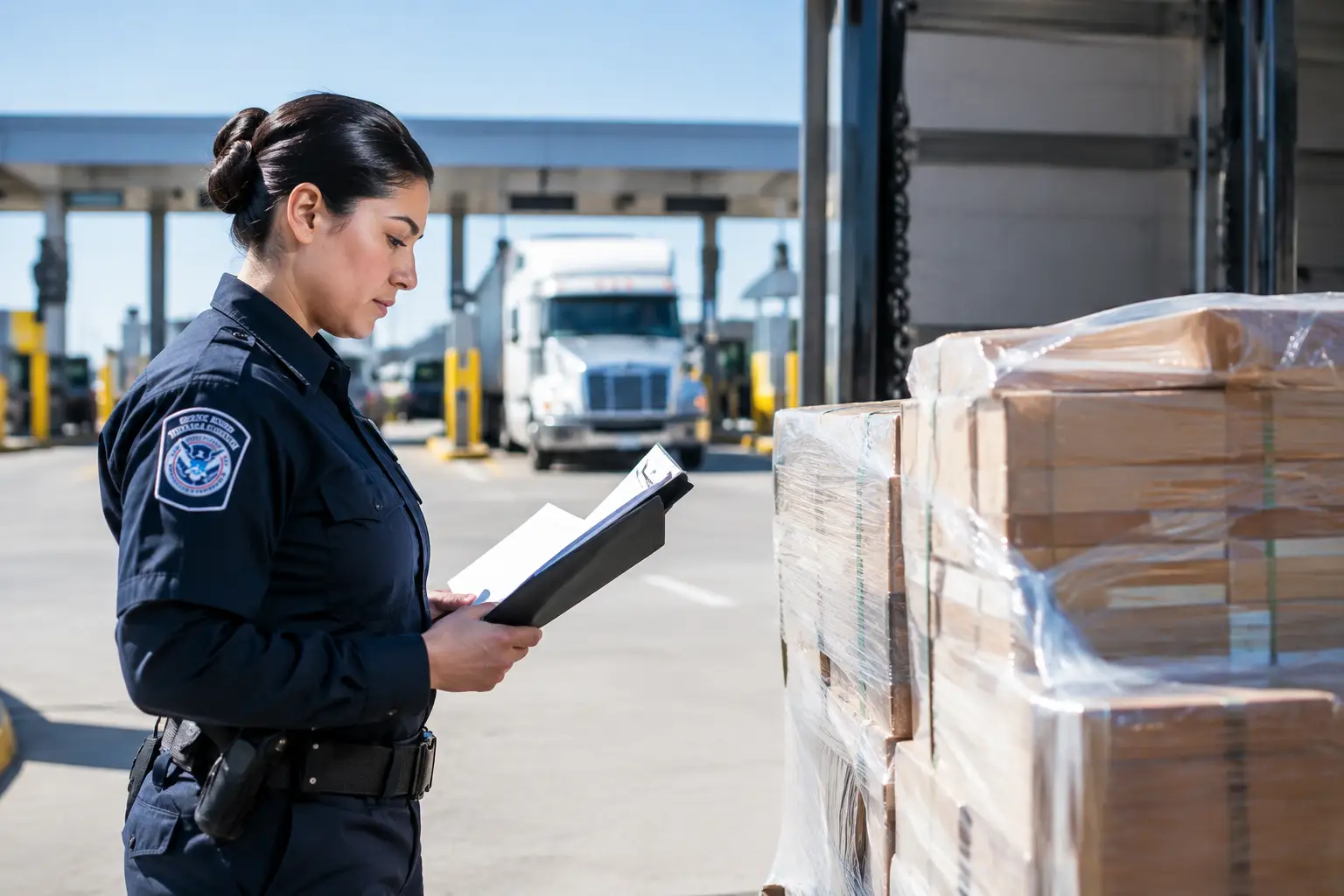
A truck can be loaded, sealed, and ready at a maquiladora in northern Mexico, yet still lose a shift at the border because one commercial invoice does not match the packing list. That is the operational problem behind this maquiladora clearance case study: the freight was not waiting on capacity. It was waiting on aligned data, clear ownership, and a process built to catch exceptions before the truck reached the port.
This representative, anonymized case reflects a common operating model for manufacturers shipping finished goods from Mexico to U.S. distribution and production sites. The shipper ran frequent cross-border moves, depended on tight outbound schedules, and had little margin for clearance errors. Its challenge was not simply filing customs entries. It was controlling the full sequence from factory documents to final delivery.
The operating environment
The manufacturer operated a maquiladora producing automotive-related components for customers in the United States. Freight moved primarily by full truckload from northern Mexico through Laredo, with delivery appointments tied to plant production schedules and regional distribution center cutoffs.
The company had capable internal transportation and trade teams. The issue was fragmentation. Plant personnel prepared shipping documents. A Mexico-side customs provider handled pedimentos. A U.S. broker filed entries. Drayage and linehaul carriers worked from separate dispatch instructions. When data changed late in the day, every party had to be notified manually.
That model can work when volume is low and every shipment is routine. It becomes fragile when the factory issues multiple loads per day, part numbers change, invoices are corrected, or a trailer arrives at the border before the paperwork has been fully validated.
The shipper was seeing recurring friction: entries delayed by invoice discrepancies, limited visibility into the status of Mexican export and U.S. import clearance, and too much time spent asking which provider owned an exception. A missed crossing did not always create a catastrophic delay. But repeated holds created overtime, rescheduled appointments, carrier frustration, and uncertainty for downstream operations.
Where the clearance process was breaking
A review of delayed shipments showed that the root cause was rarely a single customs rule. Most exceptions began with ordinary operational gaps that compounded across handoffs.
A part description on an invoice could be abbreviated differently than the description used for classification. A shipment quantity could be revised after the packing list was sent. A broker might receive a document bundle late because it was buried in an email thread shared among the plant, carrier, and customs teams. In other cases, the trailer number or seal information reached one provider but not the other.
The result was a familiar border pattern: the trailer was physically ready while the clearance record was still incomplete. The team then had to reconcile data under time pressure, often after cutoff windows had narrowed.
The manufacturer did not need another portal that required plant teams to change how they sent documents. It needed an execution layer that could receive shipment information in the existing workflow, identify missing or conflicting data, and route the right task to the right operator before freight became a border exception.
The redesigned maquiladora clearance workflow
The redesigned process treated customs clearance as a controlled workflow, not a broker handoff. BorderFlow coordinated the Mexico and U.S. sides of the move with freight execution in the same operating sequence.
Document intake started before dispatch
The first change was timing. Instead of waiting until a driver was en route or a trailer had reached the yard, the team began assembling the shipment record as soon as factory documents were available.
Commercial invoices, packing lists, manifests, and shipment instructions arrived through the channels the shipper already used, including email. Document data was extracted and organized into a shipment record, then checked against required fields for the Mexico export and U.S. import process.
This did not eliminate the need for human review. It moved review earlier, when corrections were manageable. If a quantity, consignee detail, part description, classification input, or reference number needed confirmation, the issue was surfaced before dispatch rather than during a crossing attempt.
One shipment record replaced disconnected updates
The second change was a unified operating record for the load. Mexico customs handling, U.S. entry preparation, drayage coordination, linehaul status, and delivery planning all worked from the same shipment context.
That matters because clearance data and transportation data are connected. A corrected invoice can affect the timing of the pedimento and U.S. entry. A changed trailer number can affect dispatch and border release coordination. When those updates live in separate inboxes and systems, someone has to manually connect them. That is where avoidable delays begin.
With one workflow, operators could see whether the shipment was document-ready, pending review, cleared on the Mexico side, ready for U.S. filing, held for an exception, or released for onward movement. The goal was not more status messages. It was a clear answer to a practical question: can this truck cross now, and if not, who is resolving the blocker?
Exceptions were assigned, not broadcast
The third change was accountability. Under the previous model, a document problem often triggered a broad email asking several parties to investigate. That approach creates activity, but it does not guarantee resolution.
The revised process assigned each exception to an owner with a defined next action. A factory-side discrepancy went to the plant contact. A classification or admissibility question went to the appropriate customs specialist. A trailer or dispatch issue went to the carrier coordination team. The shipment remained visible as an exception until the required data was confirmed and the clearance record was updated.
This is a simple discipline, but it changes the speed of recovery. Border teams do not need a dozen people copied on a thread. They need the correct person working the issue before the freight reaches the port.
What changed in daily operations
The most meaningful improvement was not a single clearance metric. It was predictability. The shipper gained earlier notice of document defects and a consistent way to determine whether a load was ready for movement.
The plant team spent less time reconciling repeated requests for the same shipment details. Customs teams had a more complete record before submission. Transportation planners could make dispatch decisions with a clearer view of clearance readiness. And when an exception occurred, the operating team could act on a defined issue rather than reconstructing the shipment history from email.
For high-frequency maquiladora freight, that control has a direct effect on execution. A load that is stopped for an incomplete document can miss a linehaul departure, which can miss a warehouse appointment, which can create a next-day delivery problem. Preventing the first avoidable hold protects the entire downstream plan.
There were trade-offs. Earlier document validation requires the factory to release accurate information earlier in the shipping cycle. Standardizing part descriptions and reference fields takes discipline. A unified workflow also exposes process weaknesses that separate providers may have masked. But those are productive problems. They can be managed and measured.
What this case means for maquiladora shippers
A maquiladora clearance operation should be designed around the reality that customs, trucking, and factory documentation are one process. Treating them as separate vendors and separate email chains leaves too much room for late discovery.
The right model depends on freight volume, commodity profile, port strategy, and the maturity of the shipper's internal trade controls. A low-volume operation may not need dedicated automation or tightly integrated dispatch. A manufacturer moving daily loads, supporting just-in-time production, or managing frequent part-level changes usually does.
The practical test is straightforward. If your team regularly asks whether the broker received the latest invoice, whether the pedimento is ready, or why a trailer is waiting at the border, the issue is likely workflow design rather than a lack of effort.
Border clearance performs best when document intake, compliance review, filing, dispatch, and exception management share the same operational clock. Build that control before the truck reaches the border, and the crossing becomes a planned event rather than a daily recovery exercise.