
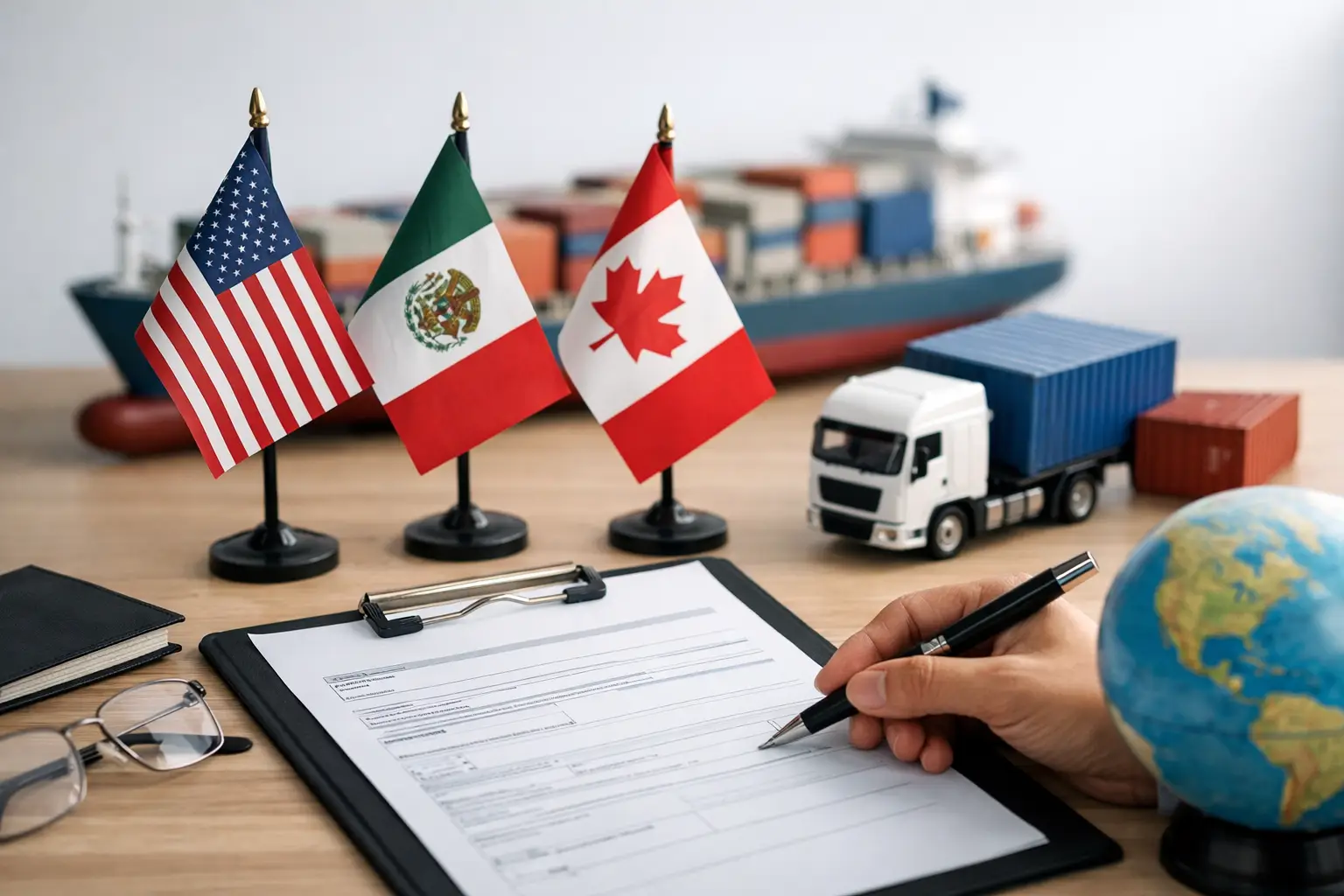
A preference claim can save duty, but it also creates a compliance position your team must be able to defend. That is the operating point of this USMCA certificate of origin guide: not producing a form for its own sake, but proving that a specific product qualifies for preferential treatment when it crosses the border.
For US-Mexico freight, the certificate is often handled late in the shipment cycle, after a commercial invoice is issued and a truck is already scheduled. That is where preventable problems start. A missing origin criterion, an unsupported tariff classification, or a blanket certification applied to a changed bill of materials can turn a duty-saving claim into a correction, a delay, or an audit exposure.
What the USMCA certificate of origin actually does
A USMCA certification of origin supports a claim for preferential tariff treatment under the United States-Mexico-Canada Agreement. It tells customs authorities that the goods meet the agreement's origin rules. It does not establish country of origin for every other customs, marking, trade remedy, or government-agency purpose.
That distinction matters. A product can be made in Mexico and still fail to qualify for USMCA preference if non-originating materials do not satisfy the applicable rule of origin. Conversely, a qualifying good may require separate analysis for marking, antidumping and countervailing duties, Section 232 duties, or other requirements.
USMCA does not require one official certificate template. The certification can appear on an invoice or be issued as a separate document, as long as it contains the required data elements and provides enough detail to identify the goods and support the claim. That flexibility reduces paperwork only if the underlying origin analysis is controlled.
The importer, exporter, or producer may complete the certification. In practice, the party making the claim should be the party that can substantiate it. An importer can certify based on its own knowledge or reasonable reliance on supplier information, but it should not treat a supplier's broad statement as proof. Accountability stays with the importer making the entry.
The nine data elements your certification needs
There is no mandated layout, but the certification must include nine core elements. Build these into a controlled document process rather than relying on a manually edited template.
- Certifier information - Identify whether the certifier is the importer, exporter, or producer, with name, title, address, email, and phone number.
- Exporter information - Provide the exporter's name, address, email, and phone number when different from the certifier.
- Producer information - Identify the producer, or state that the information is confidential or unavailable when permitted.
- Importer information - Include the importer's name, address, email, and phone number when known.
- Goods description and tariff classification - Describe the merchandise well enough to connect it to the invoice and provide the HS classification. A six-digit classification is generally sufficient for certification purposes, although the entry classification may require greater detail.
- Origin criterion - State the criterion under which the good qualifies. This is the field that should point back to your origin analysis, not a default value copied across every SKU.
- Blanket period - If the certification covers repeated shipments of identical qualifying goods, state the start and end dates. The period cannot exceed 12 months.
- Authorized signature and date - The certifier must sign and date the certification. Electronic signatures can be used where accepted, but the authorization and record trail must be real.
- Certification statement - Include a statement certifying that the goods qualify, that the information is accurate, and that the certifier will maintain records and notify relevant parties of changes that affect qualification.
The invoice reference, purchase order, manufacturer part number, and SKU are not substitutes for these elements. They are useful supporting identifiers, especially where one invoice contains multiple products with different qualification outcomes.
Why the origin criterion is where most risk sits
The origin criterion explains how a product qualifies. For many industrial shipments, this is not a simple country-of-manufacture question. The relevant product-specific rule may require a tariff shift, a regional value content calculation, a particular manufacturing operation, or a combination of tests.
The common USMCA criteria are often described as A through D. Criterion A generally applies to goods wholly obtained or produced entirely in a USMCA country. Criterion B applies when non-originating materials are used but the finished good satisfies the applicable product-specific origin rule. Criterion C generally applies where the good is produced exclusively from originating materials. Criterion D covers limited cases for certain goods that do not meet a tariff-shift requirement but satisfy other specified conditions.
Do not guess the criterion from the product's shipping origin. A Mexico-made assembly with components sourced from Asia may still qualify under Criterion B. Another Mexico-made product may not. The answer depends on the finished good's classification, the classifications and values of non-originating inputs, and the exact rule in the agreement.
Build qualification before the shipment is tendered
The cleanest workflow starts upstream with the product master, not at the border. For each product expected to claim USMCA preference, maintain an origin file that ties together the commercial description, HTS or HS classification, bill of materials, supplier origin declarations, manufacturing location, and applicable rule of origin.
For a manufacturer shipping automotive components from Monterrey to a US assembly plant, that file may also need regional value content support, labor value content data, or other sector-specific analysis. Automotive rules are more detailed than general origin rules. A standard certificate without the supporting calculation is not a control.
For distributors, the operational challenge is different. The distributor may have limited visibility into production. In that case, obtain a product-level supplier declaration with enough detail to support the claim, define its validity period, and establish a refresh process when sourcing, material composition, classification, or production changes.
A blanket certificate can reduce repetitive work for recurring lanes and stable products. It can also magnify risk. Use one only when the goods are genuinely identical and the qualifying facts are stable. A new supplier, revised component, classification change, or relocation of production can invalidate a prior conclusion before anyone updates the document.
Put the certificate into the customs workflow
A certificate that lives in an inbox is not operationally useful. Customs teams, brokers, transportation coordinators, and warehouse teams need a consistent way to identify which line items are eligible, where the supporting record sits, and whether a document is current before entry data is filed.
The control point is the entry line. Match the qualifying product identifier to the commercial invoice line, the broker's entry instructions, and the data used in the customs declaration. If only some lines qualify, claim preference only on those lines. Do not apply a blanket preference instruction to an entire shipment because most items are eligible.
For high-volume operations, document intake automation can reduce the failure rate. The objective is not another portal or a longer approval chain. It is to extract invoice data, match it to approved origin records, flag exceptions, and route only the exceptions for review. BorderFlow applies that operating model across customs documentation and entry workflows, helping teams keep execution moving without separating compliance from transportation.
The broker should receive clear, current instructions. A broker can file the claim, but the importer remains responsible for the accuracy of the declaration and supporting documentation. If a certificate is pending, expired, or limited to a different product configuration, hold the preference instruction until the issue is resolved. Paying normal duty and correcting a valid claim later may be preferable to filing a claim your team cannot support.
Records, corrections, and verification readiness
Keep the certification and the records supporting it for the required retention period. For US imports, importers generally must maintain records for five years from the date of entry. Your retention policy should also account for exporter, producer, Mexican customs, tax, and contractual requirements that may apply to the transaction.
Supporting records should show more than a signed certificate. Depending on the rule, they may include bills of materials, purchase records, supplier declarations, production records, classification workpapers, regional value content calculations, and documentation showing the origin of inputs. Store them by product and version, not just by shipment number. A verification may arrive long after the freight has been delivered.
When qualification changes, act quickly. Stop using the affected certification, notify the parties relying on it, and review entries made under the prior claim. The right corrective path depends on which country imported the goods, when the error was identified, and whether duties were underpaid or a refund is available. Treat that as a customs decision with a defined audit trail, not an email cleanup exercise.
A reliable USMCA program is built on one discipline: every duty preference claimed at the border should trace back to a controlled product-level decision. When that connection is clear, speed and compliance stop competing for attention.