
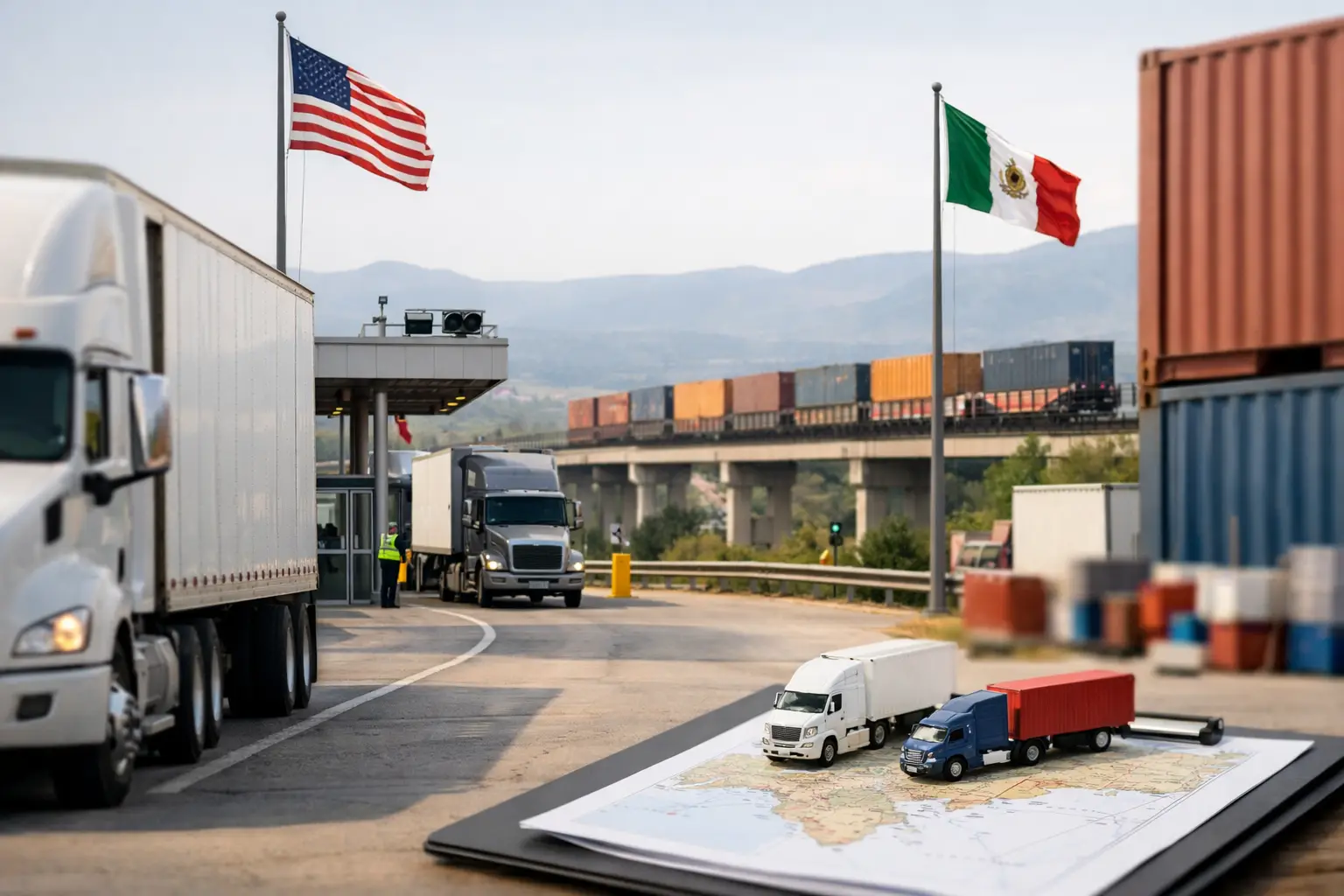
A truck can be physically at the bridge and still be hours away from crossing. The missing commercial invoice, a classification question, an unconfirmed pickup, or a broker working from stale shipment data can stop the move just as effectively as a traffic backup. That is why border logistics is not simply transportation across an international line. It is a coordinated execution system where freight, customs data, documents, carriers, and people must operate on the same clock.
For US-Mexico shippers, the real cost of a border delay is rarely limited to detention. It can mean a missed production window, an idle receiving team, a line-down risk, inventory stranded on the wrong side of the border, or expedited recovery freight that erases the margin on the load. The strongest operations do not treat customs and trucking as separate functions. They control the full handoff chain.
What Border Logistics Actually Includes
A cross-border move is often described as origin pickup, customs clearance, border crossing, and final delivery. That sequence is accurate, but it hides the operational work inside each step. Freight has to be tendered to the right carrier. Export and import documents must match the goods, values, parties, and commercial terms. Entries and Mexican pedimentos must be prepared correctly. Drayage must be timed to the clearance plan, bridge conditions, and trailer availability. The receiving location needs a realistic delivery commitment, not a guess based on when the truck departed.
Each party may be competent on its own. The failure usually occurs between parties.
A US shipper may send paperwork to a customs broker while the Mexican plant releases the freight to a carrier. The broker receives a revised invoice after the entry data has been prepared. The drayage provider learns too late that the trailer needs to be staged for inspection. A carrier gives an update that never reaches the warehouse. None of these gaps look dramatic in isolation. Together, they create unpredictable transit time and a team that spends its day chasing status.
Border logistics is the discipline of eliminating those gaps before the freight reaches the port of entry.
The Border Is a Data Handoff Before It Is a Freight Handoff
Physical freight cannot clear until its data is ready to clear. That makes document control a transportation issue, not just a compliance task.
For a typical northbound shipment, the commercial invoice, packing details, bill of lading, product descriptions, tariff classifications, country of origin information, consignee data, and applicable program documentation must support the customs filing. Depending on the shipment, the move may also require an ISF, PGA data, permits, or records supporting a preferential duty claim. On the Mexican side, the pedimento process adds its own requirements, timing, and broker coordination.
The risk is not only missing paperwork. It is mismatched paperwork. A quantity that differs between the invoice and packing list, an incomplete product description, or a classification carried over from an old product file can trigger questions when time is already tight. Teams then have to locate the right person, validate the correct data, revise the documents, and communicate the change across multiple providers.
High-performing operators move document review upstream. They establish a cutoff before pickup, define who owns corrections, and use consistent shipment data from origin through final delivery. They also distinguish between information that is merely useful and information that is required to file accurately. That focus prevents customs teams from becoming a last-minute cleanup function for every shipment.
Build Border Logistics Around One Control Point
A shipper does not need one vendor for every service. It does need one operational control point with visibility into the whole movement.
That control point should know whether freight has been released at origin, whether documents have passed validation, whether the entry is filed or pending, where the equipment is, who controls drayage, what the expected crossing window is, and when final delivery can actually occur. If no one owns that complete picture, the shipper becomes the control tower by default.
The practical workflow starts before a truck is dispatched. Shipment data arrives, documents are checked, and exceptions are identified while there is still time to correct them. Freight is then scheduled against a customs readiness status, not just a pickup request. Once the load is in motion, customs filing, bridge movement, drayage, and delivery appointments are managed as connected events.
This approach changes the conversation from, “Where is the truck?” to more useful questions: “Is the entry accepted?” “Is the freight cleared for release?” “Is the trailer positioned for the next handoff?” “What is the recovery plan if inspection occurs?” Those are the questions that protect delivery performance.
A single control point also creates accountability. When a shipment is delayed, the team can identify whether the root cause was source documentation, classification, entry timing, carrier execution, bridge congestion, inspection, or consignee readiness. Without that record, the same failure tends to repeat under a different shipment number.
Automation Should Remove Manual Customs Friction
Most cross-border teams do not need another portal to monitor. They need less rekeying, fewer inbox searches, and faster exception handling inside the workflow they already use.
The useful application of automation begins with document intake. When shipment documents arrive by email, software can extract key fields, compare values across files, identify missing information, and route exceptions to the correct operator. That reduces repetitive data entry, but the larger benefit is speed: customs preparation can begin when the documents arrive rather than when someone has time to manually open and interpret them.
Automation can also maintain an auditable operational record. Teams should be able to see when documents were received, what changed, who approved a correction, when entry data was submitted, and what customs status was returned. That history matters during an urgent escalation and during a post-shipment review.
The limit is equally important. Automation does not replace licensed customs judgment. Product classification, valuation questions, admissibility issues, and unusual documentation requirements still require experienced review. The right model automates the repetitive work and escalates the decisions that carry compliance or financial risk.
BorderFlow applies this model through customs orchestration that can work directly from email. No portal. No login. No change to your workflow. The goal is not to add software to the border process. It is to make the process move with fewer manual handoffs.
Where the Operating Model Must Flex
There is no single best border design for every shipment. A high-volume automotive lane with repetitive parts, stable classifications, and fixed receiving schedules can support a highly standardized process. A project shipment with changing quantities, specialized equipment, or uncertain production release dates needs more active exception management.
FTL and LTL also require different control points. A full truckload may offer better scheduling control and lower handling risk, but it can still fail if the trailer arrives before clearance is ready. LTL can be economical for smaller freight, yet consolidation introduces more handoffs and more opportunities for document or timing errors. The lower linehaul cost is not always the lower total cost if a missed delivery creates operational disruption.
Port selection matters as well. Laredo is a major gateway for US-Mexico trade, but using a high-volume crossing does not automatically guarantee speed. Carrier capacity, drayage coverage, customer location, customs requirements, inspection exposure, and appointment constraints all affect the right routing decision. The correct answer depends on the freight and the consequence of delay.
Measure What Causes Delay, Not Just Transit Time
Average transit time can hide a weak operation. A few late shipments may be absorbed by a favorable average while still creating costly failures at the plant or distribution center.
Track customs-ready time before pickup, document exception rate, entry rejection or correction rate, border dwell time, inspection frequency, missed delivery appointments, and the reason for every material delay. These measures expose whether the bottleneck is data quality, customs preparation, carrier execution, or downstream receiving.
The most valuable metric is often the time between receiving complete documents and achieving customs readiness. It shows whether the operation can turn information into an executable border plan. Improve that interval, and the team gains more control before freight becomes exposed to bridge congestion and real-world variability.
Reliable border performance is built upstream, in the quality of the data, the clarity of ownership, and the speed of exception resolution. When those controls are in place, the crossing becomes a managed step in the move rather than the point where everyone starts looking for answers.