
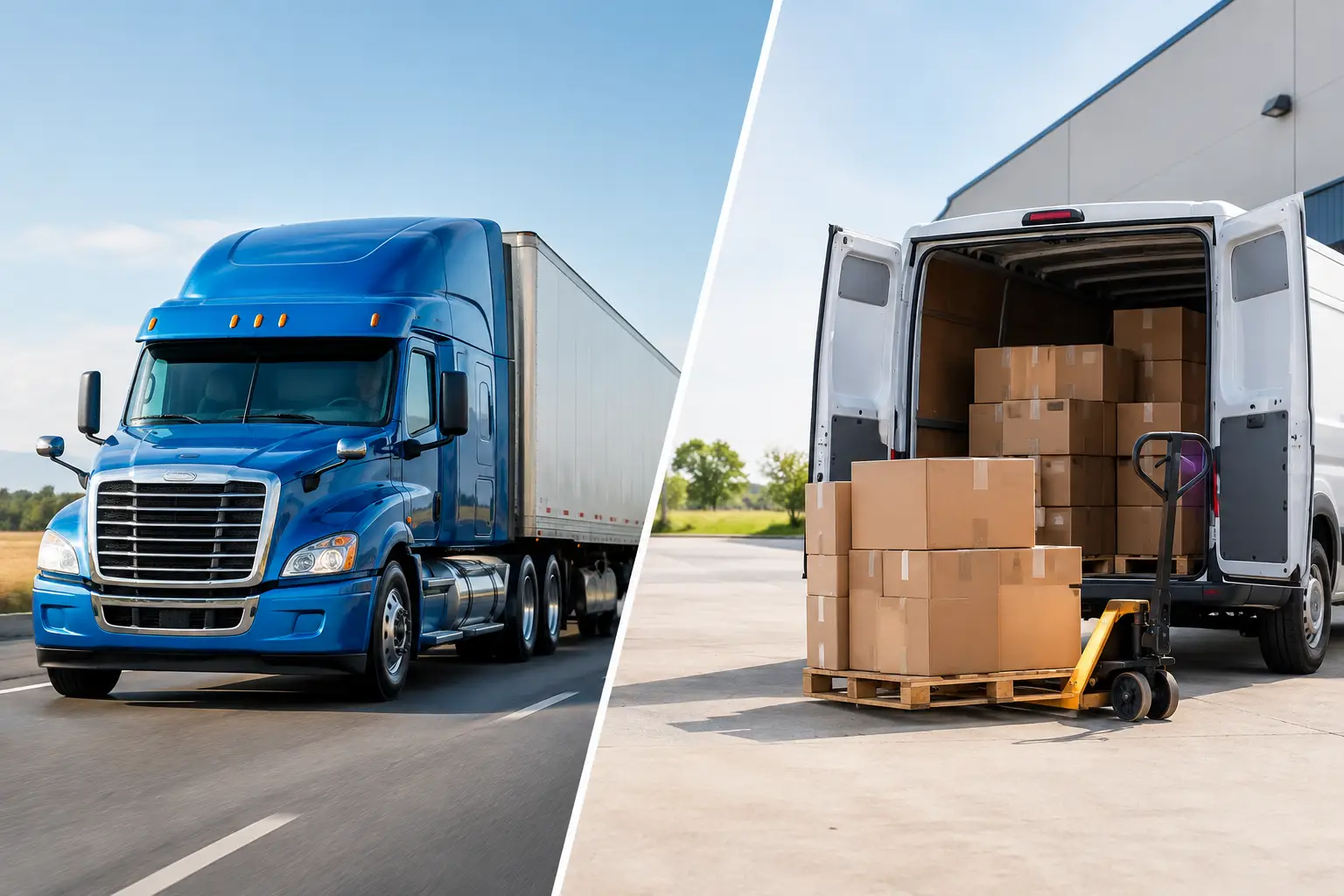
A 12-pallet shipment can be too large for a typical LTL network and too small to fill a trailer. That does not make the decision unclear. It makes the FTL vs LTL freight decision operational. For US-Mexico moves, the right mode depends on more than weight and price: customs readiness, freight sensitivity, pickup timing, border handoffs, and delivery appointments can change the economics fast.
The lowest linehaul quote is rarely the whole answer. A lower-cost mode that adds terminal handling, misses a production window, or creates document confusion at the border can cost far more than the savings on the rate confirmation.
FTL vs LTL Freight: The Core Difference
Full truckload, or FTL, reserves a dedicated trailer for one shipper. The freight moves from pickup to delivery with fewer transfers and, in most cases, no co-loaded freight sharing the trailer. You pay for vehicle capacity and control, whether the trailer is completely full or not.
Less-than-truckload, or LTL, combines freight from multiple shippers into one network. Your shipment is priced around its size, weight, density, freight class, lane, and service requirements. It is built for freight that does not justify a dedicated trailer and can tolerate network consolidation.
That distinction matters more on a cross-border lane. An FTL shipment may stay under one carrier plan through pickup, border crossing, and final delivery. An LTL shipment may move through origin terminals, a consolidation point, a border facility, and destination terminals. More touchpoints can create useful cost efficiency, but every touchpoint also requires clean data, accurate labels, and coordinated release status.
Start With the Shipment, Not the Trailer
The first question is not, Can this freight fit in a truck? Nearly every shipment can. The useful question is, What level of speed, control, handling, and risk can this shipment support?
A dedicated truck is often the better choice for high-value components, time-critical production freight, temperature-sensitive products, fragile equipment, or shipments with a hard delivery appointment. It can also make sense for freight that takes up a large share of trailer space, even when the pallets do not technically fill the vehicle.
LTL is usually the better fit for replenishment freight, lower-volume orders, and recurring shipments where cost discipline matters more than a precise transit window. It is especially effective when a shipper has consistent, well-packaged freight and can plan pickups ahead of cutoffs.
Four operating questions usually clarify the decision:
- How costly is a late delivery to the plant, warehouse, or customer?
- How much additional handling can the product tolerate?
- Does the freight need a dedicated pickup and delivery window?
- Are the commercial and customs documents ready before the freight reaches the border?
If the answer to any of the first three points is very little, FTL often earns its higher rate. If freight is stable, non-urgent, and moving in predictable volumes, LTL can reduce transportation spend without sacrificing service.
When FTL Makes Operational Sense
FTL provides control. A dedicated trailer gives the shipper more influence over pickup timing, equipment selection, routing, and delivery execution. That matters when a late arrival can stop a production line or force a warehouse to reschedule labor.
It also reduces handling. LTL freight may be unloaded, sorted, reloaded, and staged at several terminals. FTL freight usually remains in the same trailer until delivery, which lowers exposure to damage, misrouting, and pallet disruption. For machinery, automotive parts, electronics, packaged food, and other freight where handling risk carries real consequences, that difference can be significant.
Capacity is another factor. Once a shipment reaches roughly 10 to 14 pallets, occupies substantial linear floor space, or weighs enough to limit co-loading options, the apparent LTL savings can narrow. Add accessorials, appointment fees, liftgate requirements, limited-access pickup conditions, or expedited service, and a partial truckload or FTL quote may be more competitive than expected.
For cross-border freight, FTL can also simplify border execution. Fewer freight transfers mean fewer chances for paperwork to separate from the cargo or for release instructions to lag behind the truck. A full truck does not bypass customs, but it creates a more controlled operating environment for managing customs clearance and border timing.
When LTL Is the Better Freight Model
LTL is built to avoid paying for unused trailer space. For a small shipment moving on a flexible schedule, that is a meaningful advantage. Instead of buying a dedicated 53-foot trailer for six pallets, the shipper pays for the portion of capacity used.
The model works best when freight is accurately measured, properly packaged, and consistently described. Dimensions matter. Density matters. Freight class matters. A shipment quoted as a compact, stackable load can be re-rated if it arrives oversized, non-stackable, or differently classified. Those corrections can erase the savings that justified LTL in the first place.
LTL also requires realistic expectations around transit. Estimated transit days are not the same as a guaranteed appointment. Terminal networks are efficient, but they are networks. Weather, volume surges, missed cutoff times, inspection activity, and freight exceptions can affect movement. This does not make LTL unreliable. It means the shipper should use it where a little schedule variability is operationally acceptable.
For US-Mexico lanes, ask how the LTL provider handles the border. Some services depend on consolidating freight at a border terminal, transferring it to another carrier, or moving it through a cross-dock after clearance. That can be a practical model, but it must be visible. Your team should know where the freight is, which party owns the next action, and whether customs release has been confirmed before onward movement.
The Border Changes the FTL vs LTL Calculation
Domestic mode selection is mostly a capacity and service decision. Cross-border mode selection adds compliance and coordination.
Both FTL and LTL shipments need accurate commercial documents, commodity data, values, quantities, parties to the transaction, and classification support. Mexican imports require customs processing and a pedimento. U.S. entries must be filed correctly with CBP. Depending on the goods and transaction, supporting data for admissibility, valuation, country of origin, and preferential treatment may also be required.
The difference is how freight and documents move through the operating chain. With FTL, a single trailer and a more direct carrier plan can make it easier to align dispatch, customs clearance, and final delivery. With LTL, each consolidation or transfer point adds a handoff that must be managed. A release message sent to the wrong party or a commercial invoice that does not match the freight can hold up an entire load plan.
Laredo is a useful example of why coordination matters. It is a high-volume gateway with dense carrier, broker, and warehouse activity. That concentration creates capacity and options, but it also means a missed cutoff or unclear release status can quickly become a delayed pickup, storage exposure, or missed delivery appointment.
Compare Total Cost, Not Just the Freight Rate
An FTL rate is generally easier to read: equipment, lane, fuel, and any specialized requirements. LTL pricing has more variables, including class, weight breaks, dimensions, minimum charges, accessorials, and potential reclassification. Neither is inherently more predictable. Predictability comes from accurate shipment data and clear service terms.
Build the comparison around the full cost of execution. Include linehaul, fuel, border drayage where applicable, customs brokerage, transfer or cross-dock charges, detention risk, appointments, and the cost of a service failure. If a late shipment creates premium production recovery, expedited replacement freight, or customer chargebacks, the cheaper mode was not actually cheaper.
This is where a unified operating model has value. BorderFlow coordinates freight movement and customs execution in one workflow, reducing the gaps that appear when a broker, carrier, drayage provider, and warehouse are all working from different information. No portal. No login. No change to your workflow. The goal is not to force every shipment into FTL or LTL. It is to make the chosen mode executable from origin through final delivery.
Build a Mode Decision Into Your Shipping Process
Do not make this choice from scratch every time a pickup request arrives. Set practical lane rules based on pallet count, weight, cube, commodity risk, delivery criticality, and customs lead time. Then allow exceptions for high-value freight, launch activity, line-down exposure, or constrained delivery appointments.
For recurring freight, review the result after the shipment delivers. Did the LTL move get re-rated? Did the FTL trailer run half empty because an order released late? Was customs clearance complete before the truck reached the border? Those answers improve the next booking more than any generic mode rule.
The right freight mode is the one that protects the delivery commitment while keeping total landed transportation cost under control. Choose the network that gives your team the clearest ownership, the fewest preventable handoffs, and enough time to solve problems before they become border delays.