
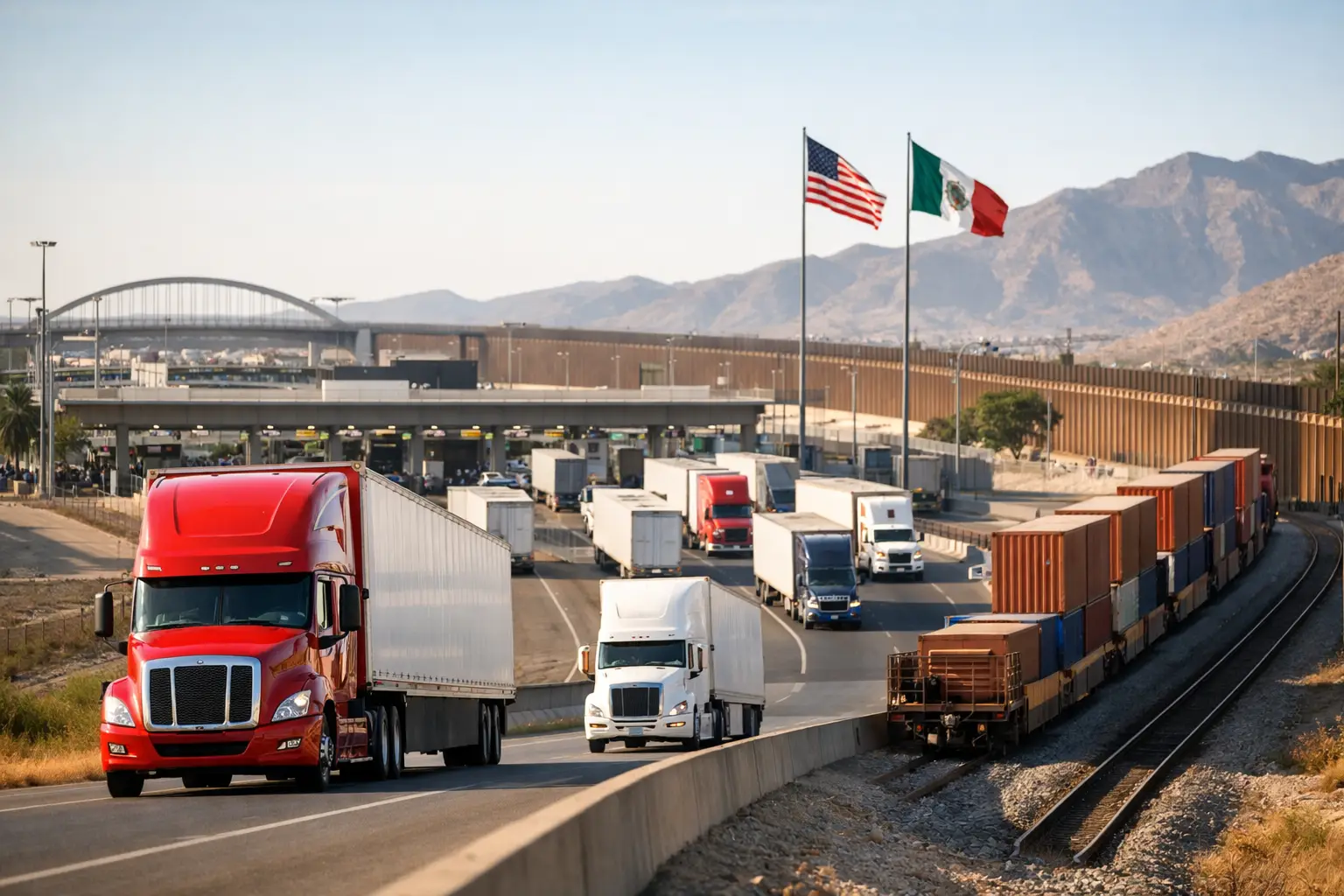
A production shift does not become a transportation plan just because a supplier opens a facility in Mexico. It becomes one when purchase orders, packaging requirements, broker data, trailers, drivers, and receiving appointments can move at production speed. That is where nearshoring freight demand trends are becoming operationally visible: more frequent cross-border moves, tighter delivery windows, and much less tolerance for border handoffs that fail.
For US-Mexico shippers, demand is not simply rising in a straight line. It is becoming more concentrated around specific industrial corridors, more sensitive to capacity swings, and more dependent on customs execution. The teams that treat freight, customs, and document control as separate workstreams will feel the pressure first.
Nearshoring freight demand trends are changing the operating model
Nearshoring brings manufacturing closer to US demand, but it also creates a denser network of cross-border dependencies. A component may move from Monterrey to a Texas assembly plant several times per week. Finished goods may then travel north to a distribution center on a fixed appointment schedule. This is different from planning a few large ocean containers weeks in advance.
The resulting freight profile often includes shorter lead times, higher shipment frequency, and a mix of full truckload and less-than-truckload freight. For many manufacturers, the constraint is no longer total annual capacity. It is whether a specific load can cross on the required day with complete paperwork, a valid entry, available drayage, and a carrier that understands the handoff sequence.
That distinction matters. A truck sitting near the port of entry is not merely a transportation exception. It can stop a production line, miss a customer delivery, consume yard space, and create avoidable customs exposure at the same time.
Demand is concentrating in established industrial corridors
Mexico's manufacturing growth is not evenly distributed. Demand is clustering around established production centers with supplier density, skilled labor, and established border routes. Northern industrial markets continue to generate significant volume, while central Mexico adds longer-haul linehaul requirements and more complex origin coordination.
Laredo remains critical because it connects major Mexican manufacturing regions to US distribution and production networks. That does not mean every shipment should route through Laredo. The right port depends on origin, destination, commodity, carrier coverage, congestion patterns, and the reliability of the full customs process. But as volume concentrates, the operational cost of choosing a route based only on a spot rate becomes clearer.
Shippers should expect lane-specific capacity conditions rather than one broad US-Mexico freight market. A carrier may have strong equipment positioning for Monterrey to Dallas but limited practical coverage for a supplier outside Saltillo with late-day pickup requirements. The rate may look attractive until missed pickup windows, transload delays, or a poorly coordinated border transfer erase the savings.
More volume does not always mean more available capacity
Nearshoring demand can increase freight volume while making dependable capacity harder to secure. The reason is operational complexity. Cross-border carriers must manage equipment balance, driver availability, border procedures, Mexican and US carrier coordination, customs timing, and delivery appointments. A trailer is only useful if every part of that sequence is aligned.
This is especially visible in just-in-time and just-in-sequence freight. A shipper may have enough carriers on paper, yet still face failures when documents arrive late, the broker lacks a complete commercial invoice, a trailer is not pre-positioned, or a load reaches the border after a cutoff. Capacity is not only a truck problem. It is a workflow problem.
Seasonality adds another layer. Automotive production schedules, retail peaks, agricultural flows, and holiday closures can change lane conditions quickly. Nearshoring also creates demand spikes when a new program launches or a supplier shifts production faster than its logistics network can absorb. Teams need a baseline plan for committed volume and a realistic exception plan for surges.
Customs data is now part of freight capacity
As cross-border volume grows, document quality becomes a capacity lever. Incomplete descriptions, inconsistent values, incorrect classifications, missing origin details, and late shipment instructions create rework at the exact point where freight needs to keep moving.
A common failure pattern is straightforward: the transportation team books the move, the supplier sends documents by email, the customs team manually reviews attachments, and an issue is discovered after the truck is already moving. The shipment then waits for corrected data while the carrier, broker, and shipper work through separate communication chains.
That model does not scale well with higher-frequency nearshoring freight. The better approach is to treat customs information as shipment-critical data from the start. Commercial documents should be checked before dispatch, product information should be structured consistently, and ownership for exceptions should be visible in one operating workflow.
Automation helps when it removes repetitive handling without forcing operations teams to change their working habits. For example, extracting data from emailed documents and routing it into customs review can reduce manual entry and surface missing fields earlier. The value is not automation for its own sake. The value is preventing a document problem from becoming a border delay.
Visibility has to include the handoffs
Many shippers can see a truck on a map. That is useful, but it does not answer the questions that matter most during a border move: Has the entry been filed? Is the pedimento ready? Has the driver reached the correct crossing? Is the trailer waiting on a transfer? Has the consignee been alerted to a changed ETA?
Nearshoring freight demand trends are increasing the number of handoffs that must be managed with precision. A typical move may involve a Mexican pickup carrier, a customs broker, a transfer operation, a US carrier, drayage, and a final-mile appointment. If each party operates from a different email thread or spreadsheet, status updates arrive after the problem has already affected delivery.
Useful visibility is operational, not decorative. It connects freight status with customs status, document readiness, border milestones, and exception ownership. It tells the logistics director what is late, why it is late, and who is accountable for the next action.
This is where a unified execution model can outperform a collection of capable vendors. BorderFlow, for example, combines brokerage, trucking coordination, and customs workflow automation so a shipment is managed as one move rather than a series of disconnected tasks. The practical benefit is fewer gaps between the person who sees a problem and the person who can resolve it.
What shippers should change before volume forces the issue
The first priority is to segment cross-border freight by operating requirement, not just spend. Separate predictable production lanes from volatile launches, urgent service parts, and low-frequency shipments. Each segment needs different carrier commitments, customs preparation rules, and escalation paths.
Next, measure the full border cycle. Do not stop at transit time from origin to destination. Track document receipt, customs filing readiness, arrival at the port, crossing completion, release, transfer time, and final delivery. A lane that appears fast overall may have large and recurring variance at one handoff.
Third, standardize supplier document expectations. Suppliers should know what data is required, when it must be sent, and how exceptions will be handled. This is not a compliance memo that sits in a shared folder. It is a production-control requirement. The earlier shipment data is validated, the fewer loads become emergency calls.
Finally, build accountability into the service design. Some shippers prefer to manage multiple specialist providers and have the internal staff to coordinate them. That can work for stable, well-resourced operations. Others need one accountable party across brokerage, drayage, carrier coordination, and delivery. The right model depends on shipment complexity and internal bandwidth, but unclear ownership is expensive in either model.
The signal to watch is variability
Rising cross-border volume is the headline. Variability is the more useful planning signal. Watch how often shipment timing changes, how frequently documents require correction, which ports create recurring dwell, and where carrier acceptance becomes inconsistent. Those indicators reveal whether a nearshoring network is truly ready for scale.
The strongest US-Mexico freight programs will not be the ones with the most dashboards or the longest carrier lists. They will be the ones that make customs readiness, border execution, and final delivery operate as a single controlled process. As nearshoring adds volume, that control becomes the difference between a closer supply chain and a faster one.