
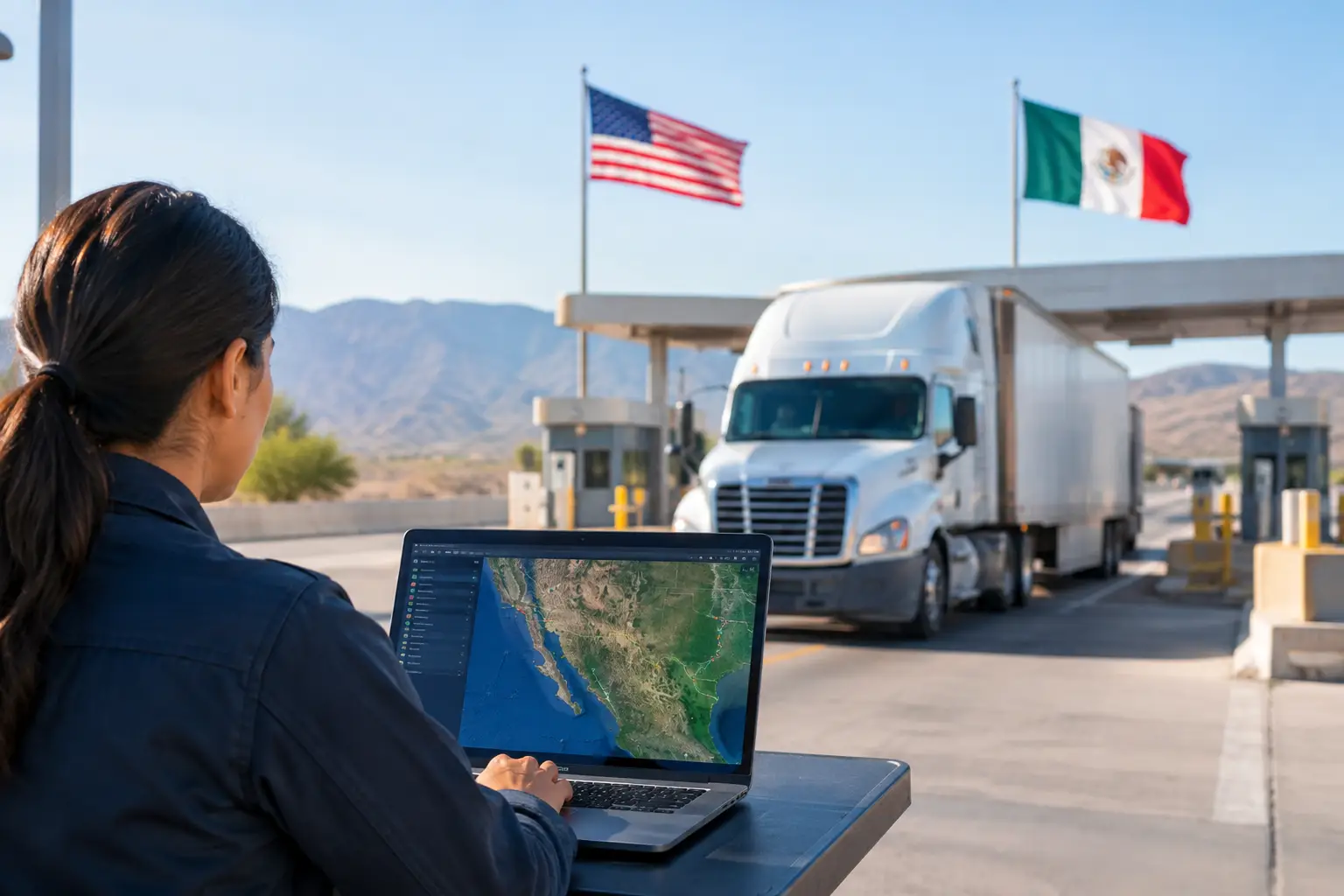
A truck can show as "at the border" for six hours while the real issue sits in an unread email: a missing commercial invoice field, an unmatched line item, a broker question, or a drayage appointment that was never confirmed. That is why top border visibility tools for US-Mexico freight must do more than place a truck on a map. They need to show what is blocking movement, who owns the next action, and whether customs and transportation are working from the same shipment data.
For cross-border teams, visibility is not a dashboard feature. It is operational control. The right tool reduces calls, stops preventable detention, shortens exception response time, and gives warehouse teams a credible arrival window instead of a vague status update.
What Border Visibility Actually Means
Standard transportation visibility platforms were built around domestic freight milestones: pickup, in transit, arrival, and proof of delivery. Those events are useful, but they leave a major gap at the US-Mexico border.
A cross-border shipment has multiple dependency chains running at once. Freight must be physically positioned, export and import documents must be complete, customs entries must be accepted or cleared, the driver and equipment must be coordinated, and the receiving operation must be ready. A missed handoff in any one of these chains can hold the entire move.
Effective border visibility connects physical status with compliance status. It tells an operator whether the truck is approaching Laredo, but also whether the US entry is filed, whether a pedimento is ready, whether a customs hold exists, and whether the transfer or final-mile appointment remains viable.
That distinction matters most for high-volume shippers. If a plant is waiting on components or a distribution center is planning labor around a delivery, "delayed" is not actionable. The team needs the cause, the owner, and the revised operating plan.
The Core Capabilities to Look For
Customs milestone visibility
Customs milestones should be visible alongside transportation milestones, not managed in a separate spreadsheet or brokerage inbox. At minimum, teams should be able to see document receipt, data validation, classification review, entry preparation, filing, release, examination or hold status, and clearance.
The useful question is not whether a provider can send clearance notifications. Most can. The question is whether the status explains the state of the file before freight reaches the border. Early visibility gives customs teams time to resolve a discrepancy while the shipment is still moving through Mexico or waiting at origin.
For US-Mexico trade, the workflow may also need to account for Mexican customs processing, pedimentos, export documentation, and importer-specific requirements. A tool that only reports US entry release provides a partial picture.
Exception management with ownership
A status feed without ownership creates more work. Every exception should have a clear condition, assigned party, timestamp, and next required action.
For example, if a tariff classification needs confirmation, the system should identify whether the importer, broker, supplier, or internal compliance team must respond. If a truck misses a border crossing window, the transportation provider should be accountable for the recovery plan. If documents are incomplete, the exception should identify the missing field or document, not just display a generic alert.
Good exception management also distinguishes urgency. A document mismatch on a shipment scheduled to arrive in two days is different from a customs hold on freight already sitting at the port. Operators need priorities, not a flat queue of alerts.
Document-level visibility
Border freight moves on documents as much as it moves on wheels. Yet many visibility programs still treat paperwork as an attachment rather than a live operational input.
The stronger tools ingest documents early, extract key data, compare that data against shipment instructions, and flag conflicts before entry submission. This can include commercial invoices, packing lists, bills of lading, certificates, purchase order data, and customs-related forms.
Document visibility matters because manual rekeying creates errors at exactly the point where errors become expensive. When transportation, brokerage, and shipper teams work from different versions of a commercial invoice, delays are not a technology failure. They are a workflow design failure.
Location data that supports decisions
GPS and telematics data have value, especially for estimating arrival times and identifying dwell. But location data alone does not explain whether a truck is eligible to cross, waiting for release, queued for inspection, or held because the receiving warehouse cannot unload.
The best visibility tools combine truck location with geofenced milestones, border crossing events, customs status, and delivery appointment data. That allows a logistics manager to distinguish between a truck that is physically delayed and a truck that is operationally blocked.
This is also where data quality matters. A precise location ping is not useful if the shipment record has the wrong trailer number, carrier assignment, or customs reference. Visibility is only as reliable as the shipment master data underneath it.
Comparing Top Border Visibility Tools by Operating Model
There is no single best platform for every cross-border operation. The right choice depends on where your team loses time today.
Carrier-focused tracking platforms
Carrier visibility platforms are often the fastest way to improve in-transit tracking. They can consolidate location data across a broad carrier network and provide estimated arrival times, dwell alerts, and lane-level performance reporting.
They work well when the biggest problem is limited awareness of where freight is after dispatch. Their limitation is that they may not have direct control of customs filing, document preparation, or border drayage. For US-Mexico freight, that can leave the highest-risk part of the move outside the platform.
Transportation management systems
A TMS is useful for tendering, carrier allocation, rating, shipment planning, and freight audit processes. Larger shippers often need it as the system of record for transportation execution.
However, a TMS implementation can be heavy, and cross-border visibility is frequently dependent on integrations with brokers, carriers, and local providers. It can become another screen that reports a problem after the operating teams have already started resolving it through email and phone calls.
Use a TMS when you need network-wide transportation control. Do not assume it will solve customs orchestration without confirming how border milestones, documents, and exceptions enter the workflow.
Customs software and broker portals
Customs software provides filing, recordkeeping, classification, and compliance management capabilities. Broker portals can provide shipment-level customs status and document exchange.
These tools are valuable for compliance teams, but they often sit apart from transportation operations. A customs analyst may know that an entry is pending, while the logistics team sees only a carrier delay. When both groups have to reconcile status manually, the shipper still owns the handoff gap.
Unified border execution platforms
A unified platform combines customs workflow, document intake, carrier and drayage coordination, shipment milestones, and exception management in one operating view. This model is most useful when speed and accountability matter more than adding another software layer.
BorderFlow, for example, uses its BorderFlow OS and Zight AI customs agent to process customs data directly from email while coordinating the execution around it. That approach matters for teams that do not want to force suppliers, warehouses, and internal users into a new portal just to get a shipment cleared and delivered.
The trade-off is that a unified model is best evaluated on execution depth, not feature count. Ask whether the provider controls the actual workflow on both sides of the border, including brokerage, documentation, drayage, and final delivery coordination.
Questions to Ask Before You Buy
Before selecting a border visibility tool, test it against a recent exception that cost your team time or money. Ask how the tool would have identified the issue, when it would have surfaced, and who would have been responsible for resolving it.
You should also ask whether the platform can ingest documents from your current workflow. If your suppliers send invoices by email and your warehouse operates from an ERP or TMS, a tool that requires everyone to log into a new portal may create adoption friction without fixing the underlying handoffs.
Confirm the data ownership model. Can the tool display live customs milestones from the actual filing process, or is it relying on manual status updates? Can it show a cross-border shipment from origin pickup through final delivery, including transfer points and drayage? Can it produce a usable exception history when a customer, plant manager, or compliance auditor asks what happened?
Finally, look at the operating team behind the software. Border visibility has a service component. When a shipment is held at the port, the value is not the alert itself. The value is having an informed operator who can act on it.
Build Visibility Around the Decisions Your Team Makes
The most effective visibility program starts with operational decisions: when to escalate a missing document, when to rebook a delivery, when to notify a plant of risk, and when to intervene before a border delay becomes a line-down event.
Choose tools that make those decisions faster and more accountable. If a platform cannot connect the truck, the customs file, the documents, and the next owner of the exception, it may provide tracking, but it does not provide control.