
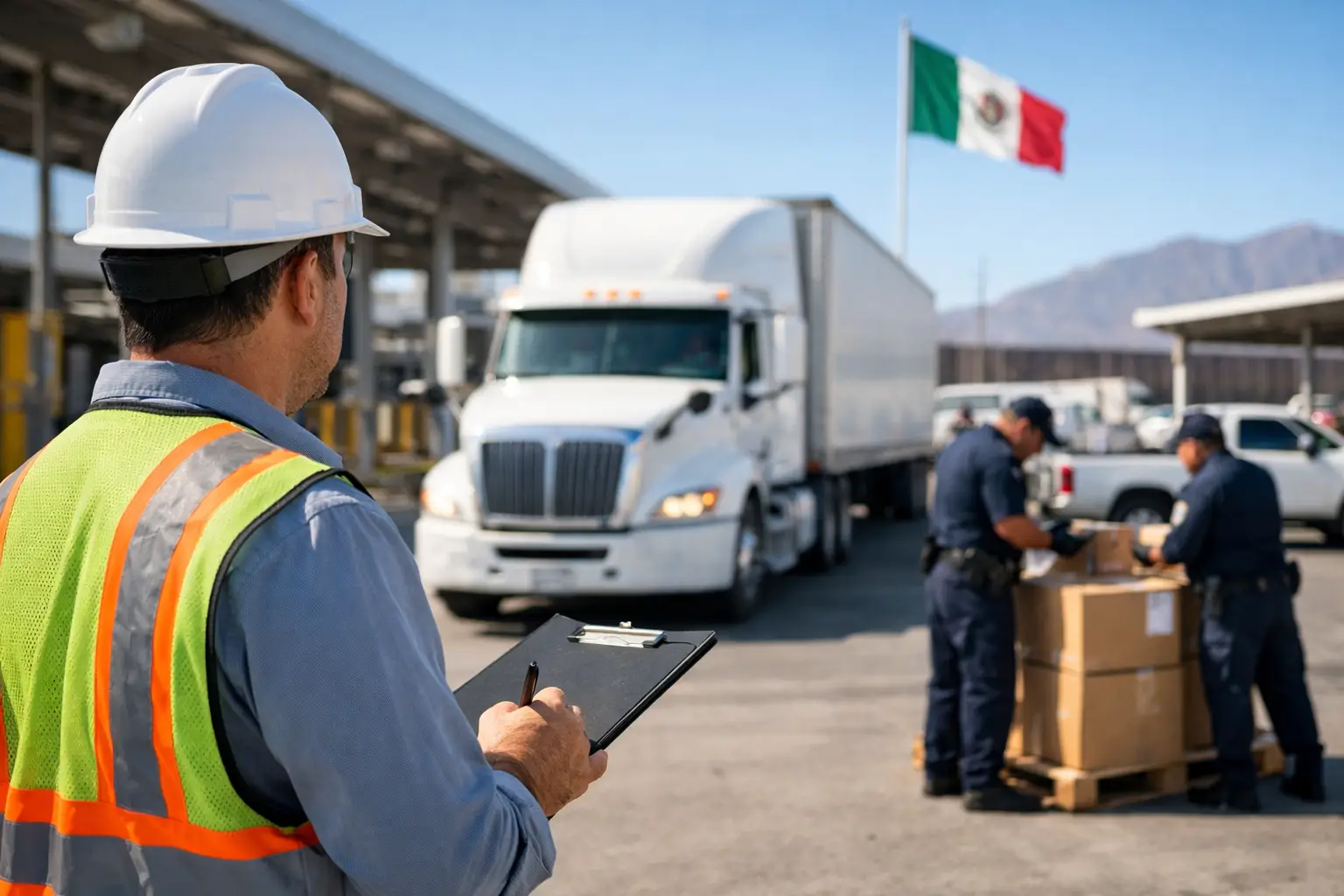
A Mexican customs broker is not the last stop before a truck crosses the border. The broker is a control point for the data, documents, tax treatment, and release process that determine whether freight moves or waits. When that function is disconnected from U.S. entry filing, carrier dispatch, drayage, and final delivery, a routine crossing can turn into hours of avoidable exposure.
For shippers moving between Mexico and the United States, the practical question is not simply, “Do we have a broker?” It is whether the broker has the correct shipment data early enough, can act on exceptions quickly, and is coordinated with every party touching the load.
What a Mexican Customs Broker Actually Does
A Mexican customs broker, commonly referred to as an agente aduanal, represents importers or exporters before Mexican customs authorities and prepares the customs documentation required to clear goods. For imports into Mexico, that often centers on the pedimento, the formal customs declaration that supports the import transaction.
The pedimento is not a simple cover sheet. It ties together the importer, supplier, product description, tariff classification, customs value, country of origin, applicable duties and taxes, and the customs regime under which goods are entering Mexico. A mistake in any of those fields can create a hold, a correction cycle, or a compliance problem that survives long after the truck leaves the port of entry.
The broker also coordinates supporting electronic records and commercial documents. Depending on the shipment, this can include invoices, packing lists, transportation documents, value declarations, certificates or origin support, permits, and product-specific compliance records. For IMMEX manufacturers, the details become even more operationally sensitive because temporary import treatment, inventory controls, and export documentation must align.
That is why a broker should not be treated as a document processor waiting at the finish line. The best outcomes come from bringing customs review upstream, while there is still time to correct a part number, confirm valuation, or resolve a missing document before a driver reaches the border.
Why Mexican Customs Clearance Breaks Down
Most border delays are not caused by a single dramatic failure. They are caused by handoffs. A supplier sends an invoice to one team. The freight forwarder sends a pickup confirmation to another. The U.S. broker receives data in a different format than the Mexican broker. Dispatch learns about a customs exception after the driver is already queued.
Each party may be doing its own job. The load still stops.
Product data is a common source of friction. Commercial descriptions such as “auto parts,” “electronics,” or “machinery components” rarely give a customs team enough detail to validate classification. A broker needs the information that explains what the item is, what it is made of, how it functions, and where it was produced. Classification can also differ between the U.S. and Mexico because Mexico uses its own tariff schedule and NICO identifiers. A U.S. HTS classification is useful context, not a substitute for Mexican classification work.
Valuation creates another failure point. Invoice values, assists, royalties, freight treatment, currency conversion, and related-party transactions can affect the declared value. A number copied from an invoice without the right context may not support the customs declaration. The correction may be possible, but it consumes time and increases scrutiny.
Then there is timing. Customs teams cannot resolve a document mismatch at the same speed when the truck is at a border facility as they can when the shipment is still at origin. Freight moves on dispatch time. Customs works on data readiness. A reliable operation makes those clocks match.
The Mexican Customs Broker Must Fit the Full Move
A broker relationship should be evaluated as part of the end-to-end transportation workflow. The broker may be highly capable at filing pedimentos, yet the shipment can still fail operationally if the carrier arrives without release confirmation, the drayage provider lacks instructions, or the U.S. side of the crossing is working from different commercial data.
For a northbound shipment, Mexican export clearance and U.S. import entry are separate legal processes. They should not be managed as separate operational events. The same shipment data needs to support both sides, while each filing reflects the applicable country requirements. The carrier, trailer, driver, pickup timing, and release status must remain visible to the people responsible for the next handoff.
For southbound freight, the sequence is equally critical. A U.S. export transaction, where required, has to align with Mexican import documentation, permits, tax treatment, and delivery instructions. If the Mexican importer is not ready, the freight does not become less urgent because the truck has crossed the first checkpoint.
This is where a unified operator model has real value. One accountable team can coordinate brokerage, transportation, and border drayage against the same shipment record rather than forcing a shipper to relay updates between vendors. BorderFlow applies that model to U.S.-Mexico freight, connecting customs execution with the physical movement instead of treating them as unrelated services.
What to Ask Before Choosing a Mexican Customs Broker
The right broker depends on your commodity mix, customs regimes, shipment volume, ports of entry, and internal process maturity. A high-volume automotive manufacturer operating under IMMEX has different requirements than a distributor importing finished consumer goods. Still, a few questions reveal whether a provider can support a controlled operation.
First, ask how shipment documents enter the process. If your team already works through email, ERP outputs, and carrier dispatch messages, requiring a separate portal may create another manual task rather than solve one. The useful question is whether the broker can extract, validate, and structure the data from the workflow your team already uses.
Next, ask what happens when information is incomplete or inconsistent. You want a defined exception process: who flags the issue, how quickly they respond, what information they need, and whether the carrier is notified before dispatch is affected. “We will let you know” is not a process.
Ask how the provider manages classification and product master data. A shipment-by-shipment approach may work for occasional freight, but repeated lanes and repeat SKUs need governed data. That means documented descriptions, tariff decisions, origin details, and clear ownership when a product changes.
Finally, ask who owns visibility once the truck is moving. Release status without transportation status is incomplete. Transportation status without customs status is equally incomplete. Your operations team needs a single view of what has been filed, what has cleared, what is held, and what action is required.
Build a Pre-Clearance Discipline
The fastest crossing is usually decided before the carrier is dispatched. A practical pre-clearance process begins when the commercial invoice and packing details are available, not when freight arrives at the border.
Start with a shipment readiness check that confirms the importer or exporter of record, commercial parties, item-level descriptions, quantities, values, country of origin, applicable classification, and required permits. For recurring freight, automate the validation of fields that should never vary unexpectedly, such as importer tax information, established part numbers, and approved product descriptions.
Then connect the customs status to dispatch. The carrier should not be operating on assumptions. If documents are pending, if a filing is incomplete, or if a release has not been confirmed, the transportation team needs that signal early enough to adjust pickup, staging, or border arrival plans.
This does not mean every shipment needs to wait for every possible issue to disappear. Freight operations involve trade-offs. An urgent production line shipment may justify a different escalation path than a replenishment load headed to a distribution center. The key is making that decision with clear customs facts, not discovering the risk in a queue.
Technology Helps Only When It Removes Handoffs
Customs technology is valuable when it reduces repetitive work without forcing operators to rebuild their day around a new system. The practical gains come from document intake, data extraction, validation rules, exception alerts, and direct submission workflows that eliminate rekeying.
A tool that collects documents but leaves teams to chase missing values manually is only partial automation. A platform that provides shipment tracking but cannot connect a hold to the exact customs document at issue is only partial visibility. The operational standard should be simple: can the team see the problem, understand the owner, and act before it becomes a border delay?
That standard matters most in high-frequency lanes through major gateways such as Laredo, where freight volume makes small process failures expensive. Speed comes from prepared data and coordinated decisions, not from asking a broker to work faster after the load is already waiting.
A capable Mexican customs broker gives your freight a compliant path through Mexico. A coordinated customs and transportation workflow gives your operation control over what happens next. Treat customs data as part of the shipment plan from the first document, and the border becomes a managed checkpoint rather than a daily surprise.