
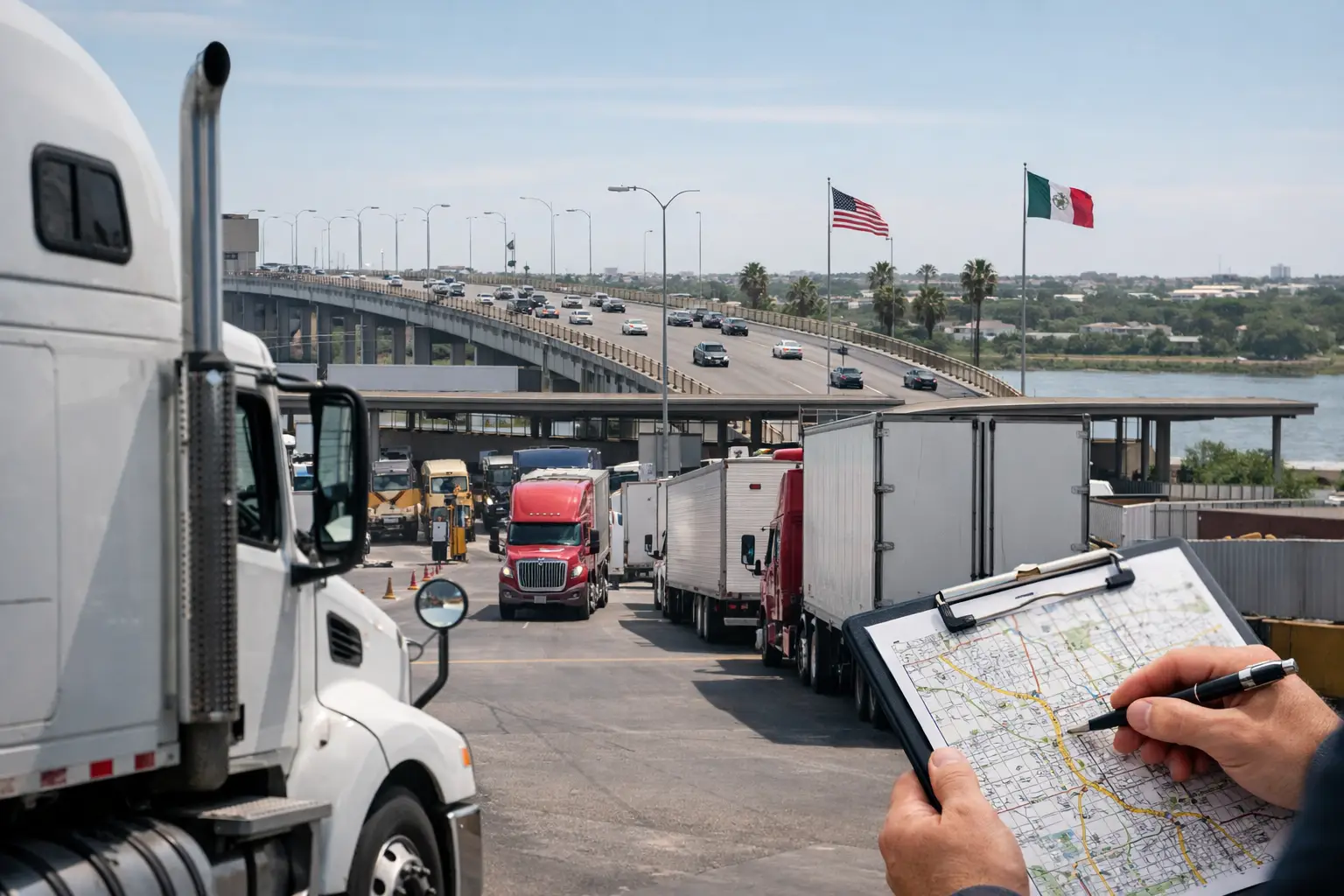
Laredo is not simply a line on a carrier’s map. It is a high-volume operating environment where one missing commercial invoice field, an unplanned drayage handoff, or a late customs release can put an entire production schedule behind. To route freight through Laredo successfully, shippers need to design the movement around customs readiness, bridge capacity, carrier control, and final-mile execution - not just a rate quote.
For US-Mexico freight, the route decision starts before a truck reaches the border. The strongest programs treat Laredo as an integrated part of the supply chain: origin pickup, document collection, export processing, customs entry, crossing, delivery appointment, and exception response all run in one accountable workflow.
Why Route Freight Through Laredo?
Laredo is a primary gateway for trade between the United States and Mexico, particularly for freight moving between industrial regions in Monterrey, Saltillo, Bajio, and central Mexico and distribution or manufacturing locations across the US. Its carrier density, warehouse infrastructure, customs presence, and established cross-border lanes make it a practical choice for both full truckload and less-than-truckload freight.
That scale also creates pressure. Heavy volumes can magnify small operational mistakes. A shipment may be physically close to the bridge but still unable to cross because the pedimento is incomplete, the US entry has not been transmitted, a commodity detail needs clarification, or the driver does not have the correct release instructions.
Laredo is often the right gateway when it aligns with your freight network, transit commitments, and customs operating model. It is not automatically the right answer for every shipment. Freight destined for the western US, for example, may perform better through another port depending on origin, carrier capacity, border wait conditions, and total miles. The correct decision is based on end-to-end transit and risk, not the apparent simplicity of a familiar crossing.
Build the Route Around the Actual Shipment
A reliable routing plan starts with the freight itself. Commodity, value, origin, Incoterms, shipper and consignee roles, trailer type, and delivery requirements determine what must happen before the truck departs.
For a standard FTL shipment from Monterrey to a Dallas distribution center, Laredo may offer a direct and efficient path. But “standard” can become complicated quickly when the load includes regulated goods, temporary imports, multiple commercial invoices, split delivery requirements, or a customer appointment with no flexibility. These details affect customs preparation, equipment assignment, crossing timing, and dispatch instructions.
The route plan should answer operational questions early:
- Is the shipment moving as a through-trailer move, a transload, or a drayage handoff?
- Which party is responsible for Mexican export clearance and the US customs entry?
- Are all invoices, packing lists, classifications, and shipment references available before pickup?
- Does the consignee require a specific trailer, seal process, appointment window, or delivery document?
- What happens if the freight misses the planned crossing window?
Those answers should live in the shipment workflow, not in separate email threads between a broker, carrier, warehouse, and customs team. Fragmented ownership is where preventable border delays start.
Customs Readiness Determines Border Speed
The fastest truck at the bridge cannot make up for late or inaccurate customs data. Freight should be evaluated for customs readiness before it is tendered, especially for repeat lanes where teams assume the paperwork will be routine.
On the Mexico side, the pedimento and supporting documentation must align with the cargo, exporter, importer, tariff treatment, and applicable regulations. On the US side, the entry data must be complete enough for the customs broker to file accurately and respond to questions without holding the load.
Classification deserves particular attention. An outdated HTS classification, a vague product description, or a mismatch between the invoice and the actual goods can create friction that no dispatch team can solve at the bridge. The same is true for valuation data, country of origin, quantities, and part numbers. Customs work is not an administrative step after routing. It is a release-critical component of routing.
A disciplined process collects documents at the earliest practical point, validates key data, and flags exceptions before equipment is dispatched. BorderFlow OS and Zight AI are built around that operating reality: shipment documents can be received through existing email workflows, extracted, reviewed, and moved toward entry preparation without requiring the shipper to work inside another portal.
Control the Handoffs at the Border
Cross-border freight has more handoffs than a domestic load. A single movement may involve a Mexican carrier, export broker, yard or drayage provider, US customs broker, US carrier, and destination warehouse. Each party may be competent. The shipment still fails if they are working from different instructions or different versions of the documents.
The practical goal is one operating plan with clear ownership at every transition. Who confirms that the trailer is ready? Who receives the customs release? Who tells the driver to proceed? Who coordinates a secondary inspection or an entry correction? Who updates the consignee when transit changes?
If the answer is “someone will call around,” the route is not controlled.
For through-trailer moves, confirm carrier authority, equipment compatibility, insurance requirements, driver procedures, and tracking visibility before tendering the lane. Through moves can reduce handling and improve transit, but they depend on the right carrier network and disciplined coordination on both sides.
For transfer or drayage models, plan the yard movement as carefully as the highway movement. Transloading can provide equipment flexibility and may help with certain lane structures, but it adds touches, labor exposure, and another timing dependency. It can be the right model for volume consolidation, specialized equipment, or carrier constraints. It is not automatically cheaper once delay risk and handling costs are included.
Time the Shipment for the Full Cycle, Not the Bridge Queue
Shippers often focus on bridge wait time because it is visible. The more meaningful metric is total cycle time from origin release to destination receipt. That includes document preparation, pickup, export clearance, queue time, crossing, import release, handoff, linehaul, and appointment delivery.
A late-day pickup in Mexico can look efficient on paper but may arrive at the border after the customs team’s cutoff for an exception. Likewise, crossing early may not help if the destination cannot receive freight until the following day and the carrier has no secure holding plan.
Build cutoffs into the route design. Establish when documents must be received, when data must be approved, when the truck must be loaded, and when an issue becomes an escalation. For high-priority freight, define a decision owner who can approve corrective actions quickly, whether that means revising an entry, reassigning equipment, changing the crossing plan, or communicating a revised ETA to the customer.
This is where visibility has to be operational, not decorative. A map pin is useful, but it does not tell a customs team whether release data is complete or tell a warehouse whether a trailer can still make its appointment. Good visibility connects location, customs status, document status, carrier milestones, and the next accountable action.
Use Exceptions to Improve the Lane
No border lane runs without exceptions. The differentiator is whether exceptions are treated as isolated emergencies or as data for improving the process.
Track the reason behind every significant delay: missing invoices, classification questions, incorrect consignee details, carrier arrival variance, inspection, equipment shortages, broker response gaps, or destination appointment failures. Over time, patterns become clear. If the same supplier repeatedly sends incomplete descriptions, the fix is upstream document standards. If a particular handoff regularly adds hours, redesign the carrier or drayage plan.
Do not measure a Laredo lane only by whether freight crossed. Measure document-ready time, release-to-cross time, pickup-to-delivery transit, exception frequency, and the number of manual touches required per shipment. Those metrics reveal whether the operation is getting faster or merely working harder to recover from the same problems.
Make Laredo Part of One Accountable Workflow
The most reliable way to move freight through Laredo is to remove the gaps between transportation and customs execution. A carrier should not be waiting for a broker update that the shipper assumes was already sent. A customs team should not be chasing documents after the trailer is loaded. A consignee should not learn about a missed appointment only after freight has crossed.
Treat the border as a controlled sequence of actions, with shared shipment data and a clear owner for every exception. When the documents, entry filings, drayage, carrier dispatch, and delivery plan move together, Laredo becomes what it should be: a high-capacity gateway, not a recurring source of uncertainty.
The next shipment is the right place to start. Map every handoff, set a document cutoff that works in the real world, and assign one owner to act before a minor discrepancy becomes a border delay.